
Saints Queen of Scots and patroness of Scotland · Feast November 16
Saint Margaret of Scotland
Feast 16 November · Born 1045 AD, Hungary · Died 1093 AD, Edinburgh Castle, Scotland
Born in exile and driven to Scotland by a storm, St. Margaret married its king instead of entering the cloister, fed its poor, reformed its Church, and died at prayer days after he was killed near Alnwick.
Begin the life
In brief
Saint Margaret of Scotland, also called Margaret of Wessex, was an English princess born in exile in Hungary. About 1070 AD she married King Malcolm III of Scots and was his queen for more than twenty years. She died at Edinburgh Castle on November 16, 1093 AD, and the Church keeps her memorial on that day.
-
Until 1066 AD
A princess born in exile
St. Margaret grows up far from England, then loses her father within days of coming home.
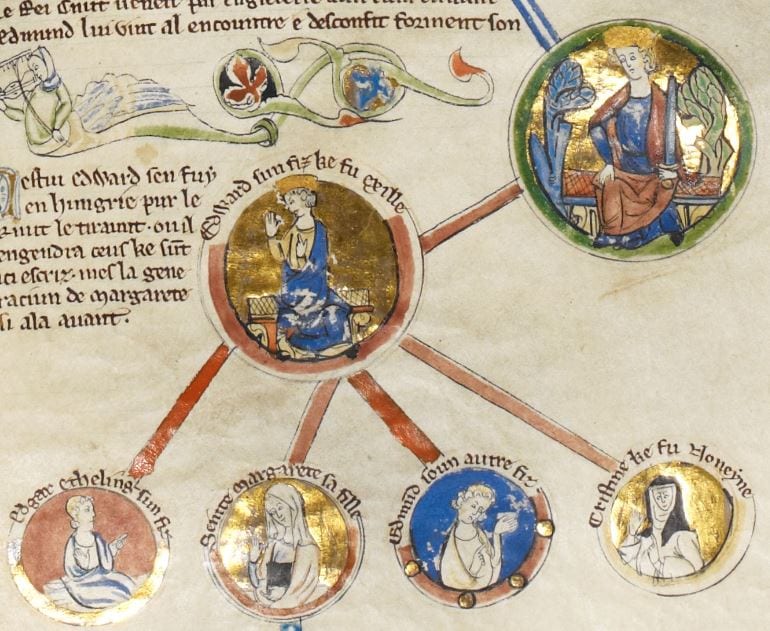
Genealogical Chronicle of the English Kings, membrane 3: Edmund Ironside, his son Edward the Exile, and Edward's children Edgar Ætheling, Margaret, Edmund and Christina, Unknown English illuminator, c. 1275–1300 AD (Commons category date; the file page says '13th century (circa 1250 AD)') Unknown English illuminator, British Library, Royal MS 14 B V St. Margaret was born in Hungary, the eldest of three children. Her father, Edward the Exile, was a son of King Edmund Ironside of England and had grown up in Hungary. In 1054 AD two English churchmen set out to bring the family home.
The family came to England in 1057 AD, when St. Margaret was about twelve. Her father died soon after landing, before he could meet his uncle, St. Edward the Confessor. At the English court she learned Latin and read the Scriptures, and she and her sister, Christina, lived under strict rules kept by the woman in charge of the young ladies there.
-
1066 AD–c. 1070 AD
A storm, a king and a wedding
After the Norman Conquest a storm blows St. Margaret's family into the Firth of Forth, and the king who shelters them wants her for his wife.
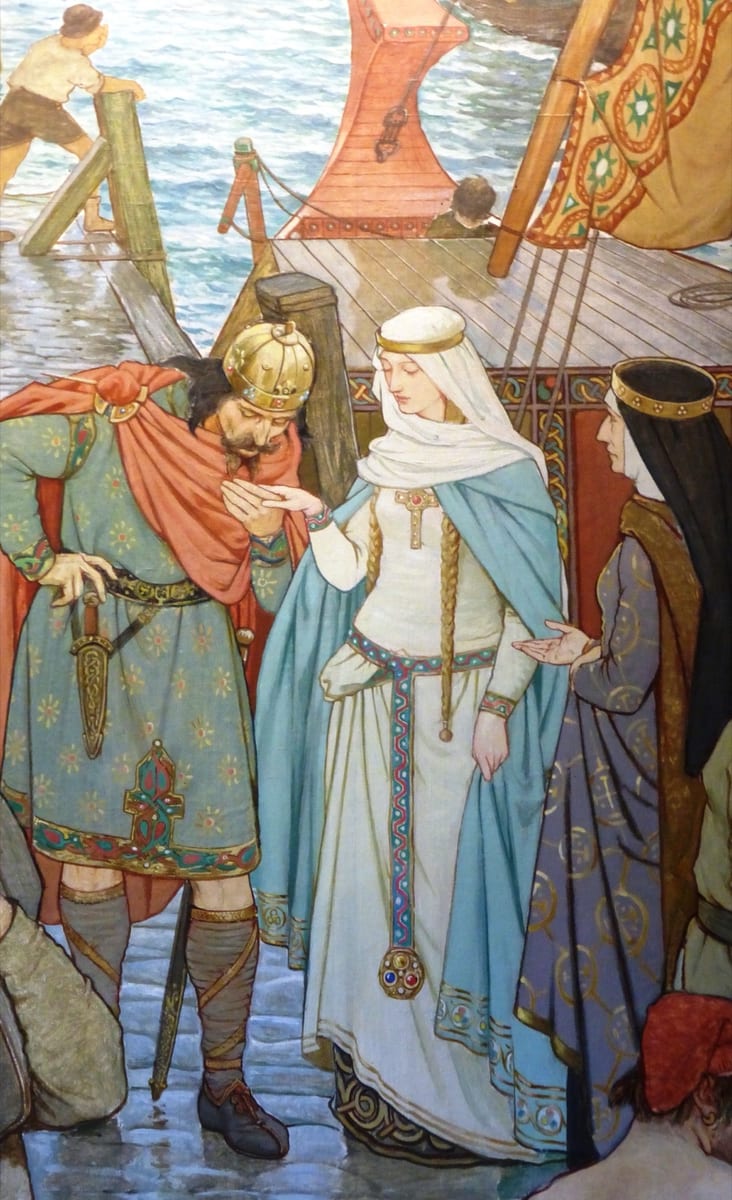
Malcolm and Margaret at Queensferry (detail of a mural), William Hole (1846–1917 AD); photograph by Kim Traynor, c. 1899 AD William Hole (1846–1917 AD); photograph by Kim Traynor, Scottish National Portrait Gallery, Edinburgh In 1066 AD William of Normandy killed King Harold at Hastings, and St. Margaret's family lost any hope of the English crown. Her mother, Agatha, decided to take the children back to the Continent, but a storm drove their ship into the Firth of Forth. King Malcolm III of Scots, a widower of about forty, took them in and wanted to marry St. Margaret.
St. Margaret held back, because she wanted to enter religious life. Her confessor, Turgot, who later wrote her life, says she married to obey the wishes of her friends rather than her own. They married about 1070 AD at Dunfermline, and soon afterwards she built a church of the Holy Trinity where the wedding had been held.
“For as Hester of old was, through God's providence, for the salvation of her fellow-countrymen, joined in wedlock to King Ahasuerus, even so was this princess joined to the most illustrious King Malcolm.”
Turgot, as Fordun's Chronicle quotes him to readers, on her marriage -
1070–1093 AD
The book in the river
A king who cannot read has his wife's books bound in gold, and her favourite Gospel book comes back out of a river.
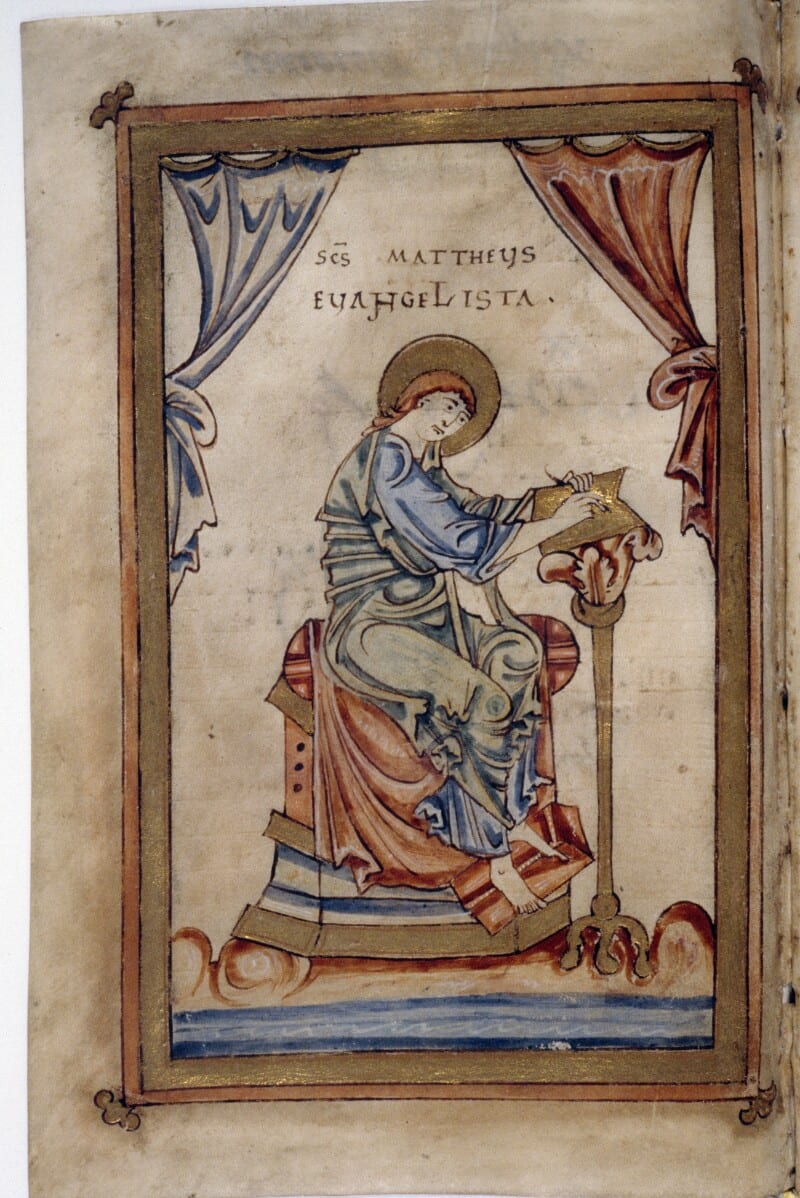
St. Margaret's Gospels (Gospel lectionary), fol. 3v: St. Matthew the Evangelist, Unknown English illuminator (the page); Bodleian Libraries photograph, probably second quarter of the 11th century AD Unknown English illuminator (the page); Bodleian Libraries photograph, Bodleian Library, Oxford, MS. Lat. liturg. f. 5 King Malcolm could not read, but he handled the books St. Margaret used and kissed the ones she loved. He had her books bound in secret with gold and precious stones. Her favourite was a Gospel book painted with gilded pictures of the four Evangelists.
Crossing a ford, an attendant dropped it into the river without noticing. Days later it was found lying open on the riverbed, almost undamaged. The book survives in the Bodleian Library in Oxford.
“I believe that this wonder was wrought by our Lord out of His love for this venerated queen.”
Turgot to readers of the Life, on the recovery of her Gospel book from the river -
1070–1089 AD
Three days before the clergy
St. Margaret argues with the Scottish clergy over Lent and Easter Communion, with her husband translating every word.
St. Margaret had the Scottish clergy meet in councils, and at the chief one she argued with them for three days. She did not speak Gaelic, so King Malcolm interpreted for both sides. Some Scots began Lent on a Monday and fasted only thirty-six days; after the council they kept all forty.
Many stayed away from Communion even at Easter, afraid to receive it as sinners. She answered that no one is free of sin, so by that rule no one could ever receive. From then on they received Communion at Easter.
“What! shall no one that is a sinner taste that holy mystery? If so, then it follows that no one at all should receive it, for no one is pure from sin; no, not even an infant whose life is but one day upon the earth.”
St. Margaret of Scotland to the Scots clergy, at the council on receiving Communion at Easter -
1070–1093 AD
Orphans, captives and pilgrims
The queen feeds orphans with her own hands, buys English captives out of bondage and ferries pilgrims across the Forth for nothing.
Each morning nine destitute orphans were brought to St. Margaret, and she fed them with her own spoon. In Advent and Lent she and the king served three hundred poor people in the royal hall. She sometimes gave away things that belonged to the king, and he did not mind.
She sent agents secretly through Scotland to find English captives and paid their ransoms. For pilgrims bound for St Andrews she built hostels on both shores of the Forth. Her boats carried them across without charge, at the crossing still called Queensferry.
“She was poorer than any of her paupers, for they, even when they had nothing, wished to have something, while all her anxiety was to strip herself of what she had.”
Turgot to Queen Matilda -
1093 AD
A warning from a sickbed
St. Margaret urges King Malcolm not to go with the army, and senses the campaign will end in disaster.
From the spring of 1093 AD St. Margaret could seldom rise from her bed. She said goodbye to Turgot and asked him to look after her children. King Malcolm invaded England against her urging and took two of their sons.
On November 13, 1093 AD, King Malcolm was killed by treachery near Alnwick, and their eldest son, Edward, was fatally wounded. That day at Edinburgh Castle, with no news yet, she warned those near her of a calamity for Scotland.
“Perhaps on this very day such a heavy calamity may befall the realm of Scotland as has not been for many ages past.”
St. Margaret of Scotland to the priest seated near her, at Edinburgh Castle, on the day the king fell at Alnwick -
November 16, 1093 AD
The truth, by the cross
On her last day St. Margaret receives Viaticum, makes her son tell her the truth about Alnwick, and dies at prayer.
On November 16, 1093 AD, St. Margaret heard Mass in her oratory and received Viaticum. Back in bed, she held the Black Cross, a relic of the true Cross, to her eyes and face as she prayed. Her son Edgar came back from the army and told her his father and brother were well.
She told him she already knew, and charged him by the cross to tell her the truth. When he told her, she praised God for the sorrow and said she trusted the suffering would cleanse her of some of the stains of her sins. She died saying the prayer before Communion, as she asked Christ to deliver her.
“I know it, my boy, I know it. By this holy cross, by the bond of our blood, I adjure you to tell me the truth.”
St. Margaret of Scotland to her son Edgar -
1093–1250 AD
Home to Dunfermline
Her body is carried out of a besieged castle to the church she built, where her shrine is raised after the Pope canonises her.
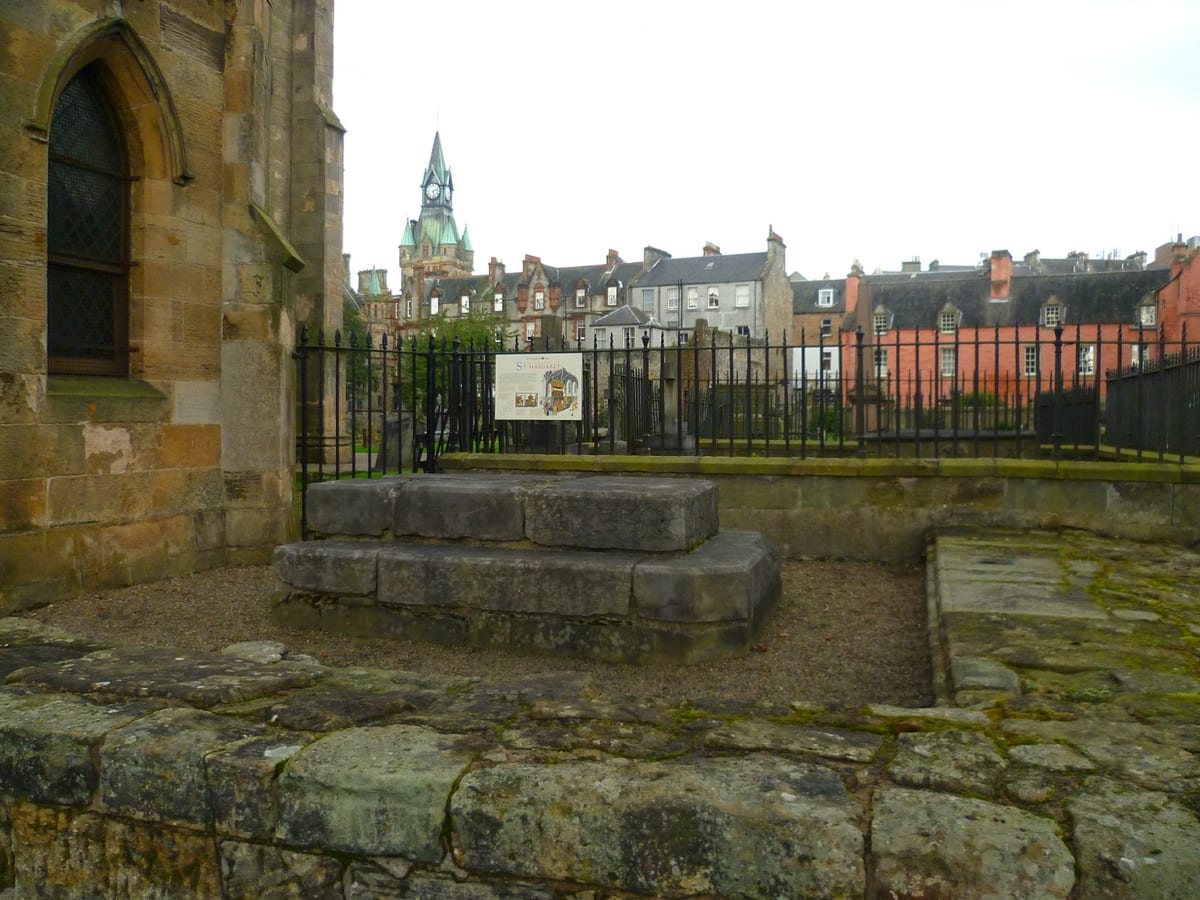
Site of the shrine of St. Margaret, Dunfermline Abbey, Fife, Kim Traynor, October 14, 2011 AD, 2011 AD (photograph) Kim Traynor, October 14, 2011 AD, Dunfermline Abbey (Historic Environment Scotland) After St. Margaret died, Malcolm's brother, Donald Bane, came for the throne and besieged Edinburgh Castle, where the king's heirs were. Those inside brought her body down by a small gate on the western side and took it to Dunfermline, as she had asked. According to longstanding Catholic Tradition, told by the chronicler Fordun, a great mist hid her family as they fled.
She was buried in her church of the Holy Trinity at Dunfermline, facing the altar. Three of her sons, Edgar, Alexander and David, later reigned in turn as kings of Scotland. Pope Innocent IV canonised her in 1250 AD, and her body was raised into a silver shrine.


Pray with the Church
Collect for the memorial of Saint Margaret of Scotland
The Roman Missal, collect of her memorial on November 16 (ICEL translation)
O God,who made Saint Margaret of Scotland wonderfulin her outstanding charity towards the poor,grant that through her intercession and examplewe may reflect among all humanitythe image of your divine goodness.Through our Lord Jesus Christ, your Son,who lives and reigns with you in the unity of the Holy Spirit,God, for ever and ever.
All 2 reports on Saint Margaret of Scotland

Scottish king refuses to surrender St. Margaret to William the Conqueror
