Saints Visitation nun of Paray-le-Monial · 1647–1690 AD
Saint Margaret Mary Alacoque
Feast 16 October · Born 1647 AD, Lhautecour, parish of Verosvres, Charolais, Burgundy, France · Died 1690 AD, Visitation monastery, Paray-le-Monial, Burgundy, France
The Burgundian nun of Paray-le-Monial who received the revelations of the Sacred Heart, and the feast she was told to ask for.
Begin the life
In brief
Saint Margaret Mary Alacoque entered the Visitation monastery at Paray-le-Monial in Burgundy in June 1671 AD. In its choir Christ opened his Heart to her and asked for a feast in its honour. She died there at forty-three, and the Church granted the feast in 1765 AD.
-
1647–1662 AD
Lhautecour
A notary's daughter in the Charolais, schooled by the Poor Clares, then four years in bed.
Saint Margaret Mary Alacoque was born at Lhautecour, in the Charolais of Burgundy, on July 22, 1647 AD. Her father, Royal Notary Claude Alacoque, died at the close of 1655 AD. Her mother then boarded her with the Poor Clares at Charolles.
She made her First Communion there at nine. A rheumatism complicated by paralysis then held her four years in bed. She vowed herself to the Blessed Virgin, and was cured within days.
“This Communion shed such bitterness over all my little pleasures and amusements that I was no longer able to enjoy any of them, although I sought them eagerly.”
St. Margaret Mary Alacoque -
1663–1671 AD
The years at home
Shut in at Lhautecour, pressed to marry, and gone to Paray at twenty-three.
At Lhautecour her mother lost all authority in the house. She needed the consent of three persons before she could go out. Villagers brought her milk or fruit in the evening.
From about eighteen she had several offers of marriage. Her mother told her that if she left she would die of grief. She dismissed the suitors, and entered the Visitation at Paray-le-Monial on June 20, 1671 AD.
“It appeared to me that I was like a slave who sees herself released from her prison and her chains, in order that she may enter the house of her Spouse to enjoy, without reserve, His presence, His wealth and His love.”
St. Margaret Mary Alacoque -
1671–1672 AD
Sister Margaret Mary
The habit, a novitiate under suspicion, and profession at twenty-five.
She received the habit on August 25, 1671 AD. She did not understand the instruction on prayer she was given, and did not dare say so. The graces she received became visible, and she was warned she might not be professed.
Her brother had made exemption from cheese a condition of her dowry contract. Ordered to eat it, she struggled three days, then took it for eight years. She was professed on November 6, 1672 AD, having signed her self-offering in her own blood.
“Why, O my Sovereign Master, why not leave me in the ordinary way of the daughters of Holy Mary? Hast Thou then brought me to Thy holy house to destroy me? All I wish for is Thy love and Thy Cross, that suffices for me to become a good religious, which is all I desire.”
St. Margaret Mary Alacoque -
1673–1675 AD
The Heart opened
Revelations in the choir at Paray, and a request she could not carry alone.
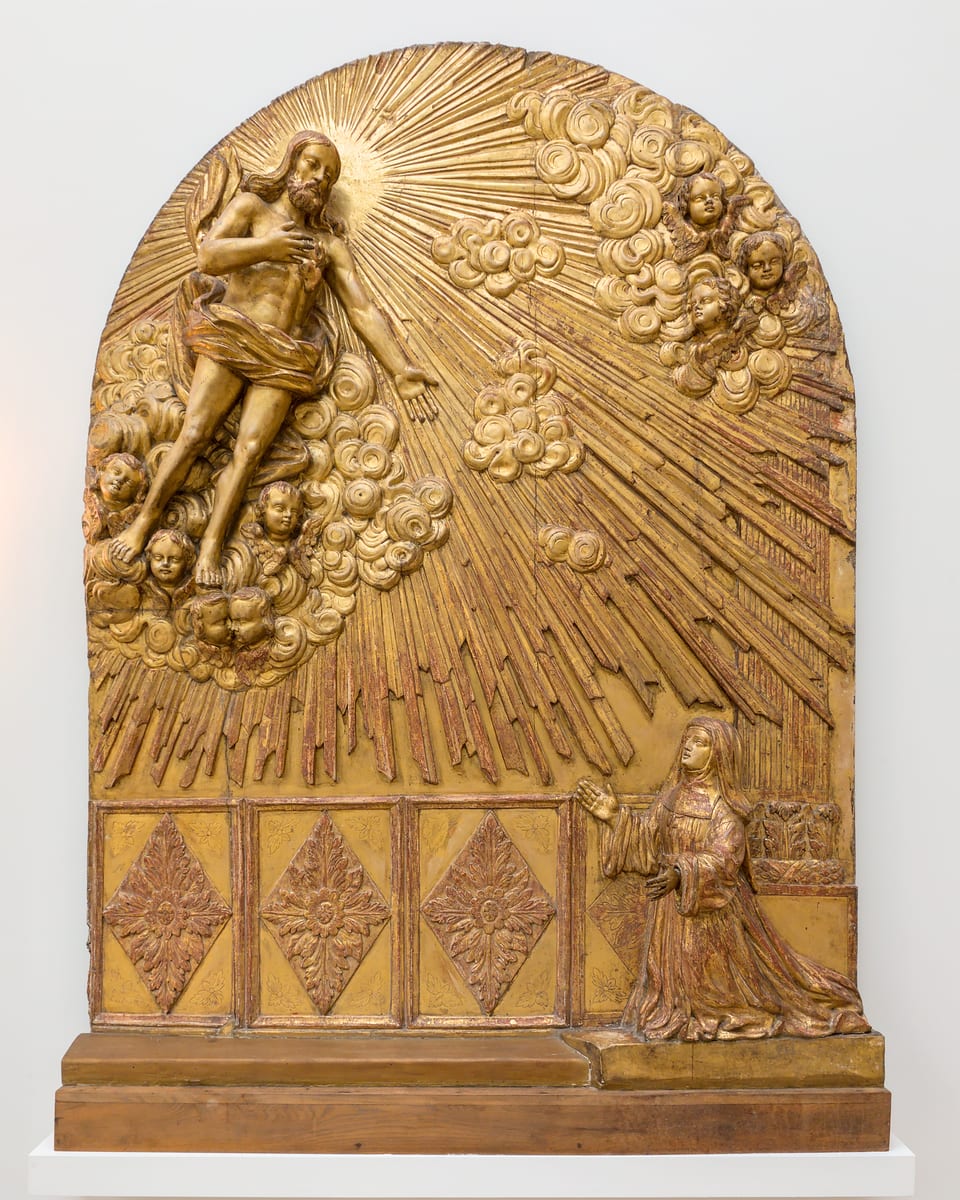
Apparition du Christ à Marguerite-Marie Alacoque, Unknown, 18th century, 18th century (photograph of the painting, 2025 AD) Unknown, 18th century, Musée du Hiéron, Paray-le-Monial (Saône-et-Loire, France); photograph by Benjamin Smith On December 27, 1673 AD Christ opened his Heart to her in the choir at Paray. A second revelation asked her to communicate on the first Friday of every month. It asked her also to rise on Thursday night and pray prostrate for an hour.
In June 1675 AD he asked for a feast of his Heart after the octave of Corpus Christi. She was told to address herself to Saint Claude de la Colombière, the Jesuit superior at Paray. Pope Pius XI records that she and St. Claude were the first of all to consecrate themselves to that Heart.
“Behold this Heart, Which has loved men so much, that It has spared nothing, even to exhausting and consuming Itself, in order to testify to them Its love; and in return I receive from the greater number nothing but ingratitude by reason of their irreverence and sacrileges, and by the coldness and contempt which they show Me in this Sacrament of Love. But what I feel the most keenly is that it is hearts which are consecrated to Me, that treat Me thus.”
Christ, as recorded by Margaret Mary, June 1675 AD -
1674–1682 AD
Not believed
Her house took her for a visionary, and her supporter Saint Claude de la Colombière died at forty.
The community treated her openly as a visionary. The directors consulted about her condemned her prayer and forbade her to follow it. On the evening of November 20, 1677 AD she dragged herself into the refectory and could not speak.
St. Claude de la Colombière had been sent from Paray to London in October 1676 AD. He was arrested there on November 26, 1678 AD, imprisoned three weeks and banished. He came back to Paray with his health broken and died there on February 15, 1682 AD.
“Everything seems a cross either to my body or my soul. Yet I cannot complain or desire any consolation save to be without all consolation in this world and to live hidden in Jesus Crucified, unknown in my sufferings, so that no creature may have compassion on me or remember me except to augment my pain.”
St. Margaret Mary Alacoque, June 1678 AD -
1685–1686 AD
The novices' feast
Seven novices keep the feast; a year later the whole community follows.
In January 1685 AD she was made mistress of novices. Her name day fell on a Friday, July 20, 1685 AD. She asked her seven novices to pay the honours meant for her to the Heart of Jesus.
The Superior then shut the devotion inside the novitiate and took away her First Friday Communion. A year later Sister Mary Magdalen des Escures, who had opposed her, dressed an altar in the choir. The community of Paray gave itself to the Sacred Heart on June 21, 1686 AD.
“I cannot express my joy at the growth of the devotion to the Sacred Heart of my Saviour. I seem to live only for that.”
St. Margaret Mary Alacoque, February 1686 AD -
1688–1689 AD
The chapel in the garden
A chapel blessed at Paray, and three requests carried to Louis XIV.
The chapel built in the convent garden was blessed on September 7, 1688 AD. Twenty-five clergy came in procession, and the ceremonies lasted two hours. St. Margaret Mary knelt motionless in the convent chapel throughout, and no one dared speak to her.
The Visitation of Paray-le-Monial holds by tradition that her ecstasy that day lasted about three hours. In August 1689 AD she wrote out three requests to be laid before Louis XIV. None of the three was complied with by the king.
“I could not refrain from looking at it, for it is so beautiful.”
St. Margaret Mary Alacoque, September 7, 1688 AD -
1690–1920 AD
The great retreat
Her death at Paray at forty-three, and what the Church did afterwards.
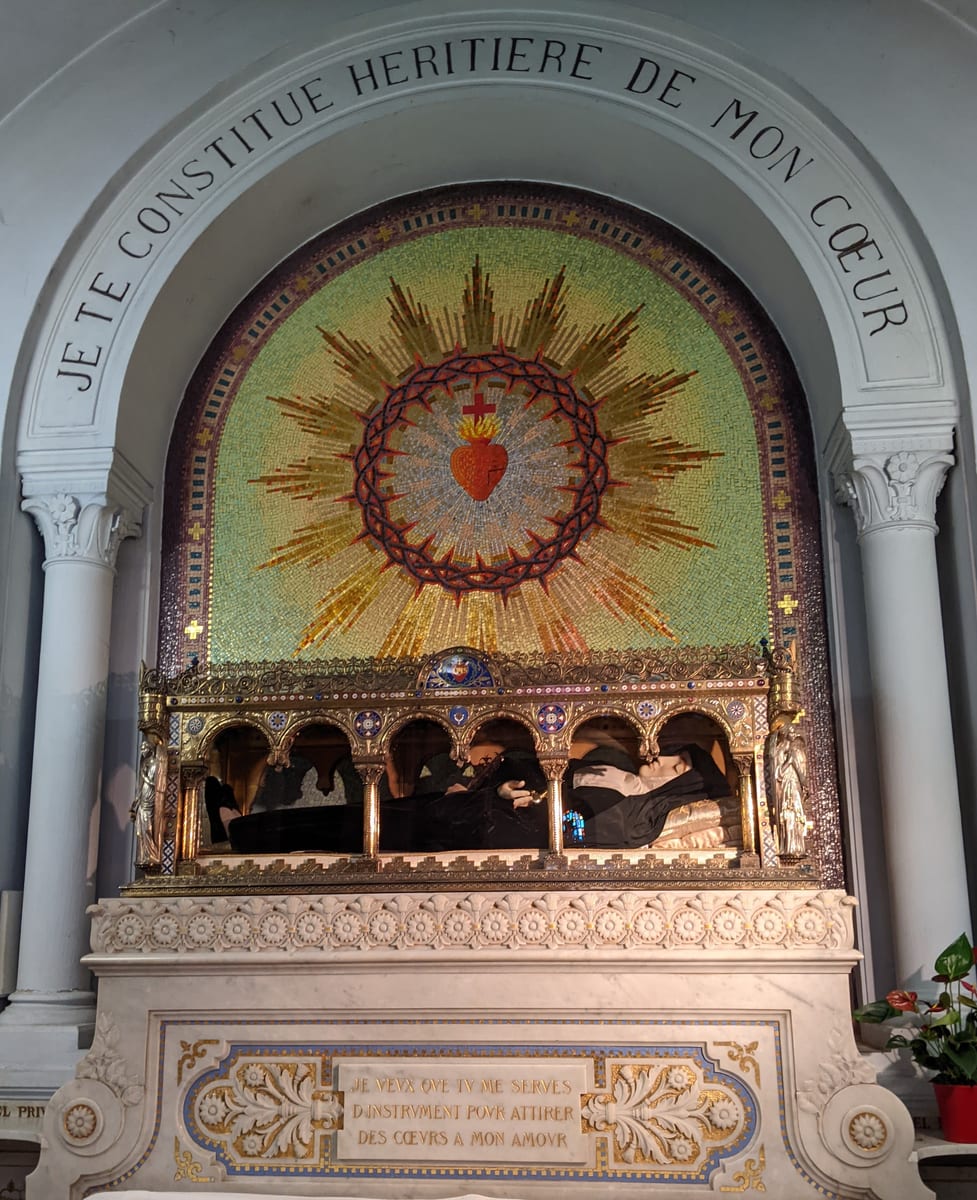
Châsse de Marguerite-Marie Alacoque dans la chapelle de la Visitation de Paray-le-Monial, Photograph by Majella1851, September 12, 2021 AD (photograph); the shrine dates from her canonisation in 1920 AD Photograph by Majella1851, Chapelle de la Visitation (Chapel of the Apparitions), Paray-le-Monial In July 1690 AD she asked leave for a retreat of forty days, as a preparation for death. She took to her bed on October 8, 1690 AD. She died on the evening of October 17, 1690 AD, in the forty-fourth year of her age.
Nothing was found in her cell but her Rule book and her discipline. Pope Clement XIII approved the liturgical feast of the Sacred Heart on February 6, 1765 AD. Pope Benedict XV canonised her on May 13, 1920 AD, the feast of the Ascension.
“Beg pardon of Him for me, and love Him with all your hearts to make reparation for all that I have failed to do. Oh! what a happiness to love God! Love Him then, for He is Love, and love Him perfectly.”
St. Margaret Mary Alacoque, October 17, 1690 AD


Pray with the Church
A prayer printed in the 1919 AD Life
The prayer of her feast, printed at the close of Sister Mary Philip's Life of Blessed Margaret Mary Alacoque (1919 AD), when she was still styled Blessed.
O Lord Jesus Christ, Who didst reveal unto Blessed Margaret Mary the incomprehensible riches of Thy Sacred Heart,grant that by her merits and example we may love Thee in all things and above all things,and so deserve to have a dwelling-place in this Thy Heart,Who livest and reignest with God the Father in the unity of the Holy Ghost, God for ever and ever. Amen.
All 6 reports on Saint Margaret Mary Alacoque

About this picture
AI-generated image, in the manner of a French seventeenth-century religious oil painting, from the paper's reference portrait based on Marguerite-Marie Alacoque (Unknown artist, 19th century, Monastery of the Visitation, Paray-le-Monial) View source artwork.

Told she will not die, St. Margaret Mary teases her doctor

About this picture
AI-generated image, in the manner of French seventeenth-century oil painting, from the paper's reference portrait based on Apparition du Christ à Marguerite-Marie Alacoque (unknown artist, 18th century, Musée du Hiéron, Paray-le-Monial; photograph by Benjamin Smith, CC BY-SA 4.0) View source artwork.
St. Margaret Mary's ulcers close without a trace before her novena ends

About this picture
AI-generated image, in the manner of French religious oil painting of the later seventeenth century, from the paper's reference portrait based on Apparition du Christ à Marguerite-Marie Alacoque (Unknown, 18th century, Musée du Hiéron, Paray-le-Monial; photograph by Benjamin Smith, CC BY-SA 4.0) View source artwork.
St. Margaret Mary writes how a Jubilee friar won over her brother

Pope Pius IX declares Saint Margaret Mary Alacoque Blessed in Rome

About this picture
AI-generated image, in the manner of French religious oil painting of the later seventeenth century, from the paper's reference portrait based on Marguerite-Marie Alacoque — Saint Margaret Mary Alacoque, religious of the Order of the Visitation of Holy Mary (Unknown, 19th century, Monastery of the Visitation, Paray-le-Monial (France)) View source artwork.
The first Sacred Heart chapel is blessed; St. Margaret Mary kneels apart

About this picture
AI-generated image, in the manner of seventeenth-century French oil painting, from the paper's reference portrait based on Apparition du Christ à Marguerite-Marie Alacoque (Unknown, 18th century; photograph by Benjamin Smith, Musée du Hiéron, Paray-le-Monial). No person is depicted and no likeness is intended. View source artwork.