
Saints King of France · 1214–1270 AD
Saint Louis IX of France
Feast 25 August · Born 1214 AD, Poissy, France · Died 1270 AD, Camp before Tunis, Tunisia
Crowned at twelve, he carried the Crown of Thorns barefoot into Paris, was taken prisoner on crusade in Egypt, and died of dysentery in the camp before Tunis.
Begin the life
In brief
Saint Louis IX of France, also known as St. Louis of France, was King of France from 1226 AD until his death in 1270 AD. His friend Jean de Joinville, seneschal of Champagne, went on crusade with him and later wrote a book of his words and deeds. The Roman Martyrology remembers him for his active faith, at home and in the wars he fought to defend Christians, and for his justice.
-
1214–1226 AD
Born at Poissy on St. Mark's day
Born on the feast of St. Mark, he was raised by a mother who told him she would rather see him dead than guilty of a mortal sin.
St. Louis was born at Poissy, in the diocese of Chartres, on April 25, 1214 AD, the feast of St. Mark. His parents were the future King Louis VIII and Blanche, daughter of the king of Castile. He was baptised at Poissy too, and in his personal letters St. Louis added the town to his own name, signing as of Poissy.
His mother brought him up under her own discipline and taught him to love God. St. Louis later recalled that she often told him she would rather he were dead than guilty of a mortal sin.
-
1226–1227 AD
Crowned at twelve at Reims
His father dies on the way home from the south, his mother has the twelve-year-old crowned at Reims, and the people of Paris bring him safely home past the barons.
St. Louis's father, King Louis VIII, died of dysentery at Montpensier in November 1226 AD and named Queen Blanche regent. She had the twelve-year-old crowned at Reims on the first Sunday of Advent, November 29, 1226 AD. Queen Blanche had come from Spain and had no relatives in France.
Some barons asked her for great lands, and when she refused they gathered at Corbeil. They lay in wait for the boy at Montlhéry, and the people of Paris came out and brought him safely home. St. Louis later told Joinville that the whole road to Paris was crowded with people, armed and unarmed, praying Christ to give him long life.
-
1239–1248 AD
Barefoot with the Crown of Thorns
The king and his brothers carry the Crown of Thorns barefoot into Paris.
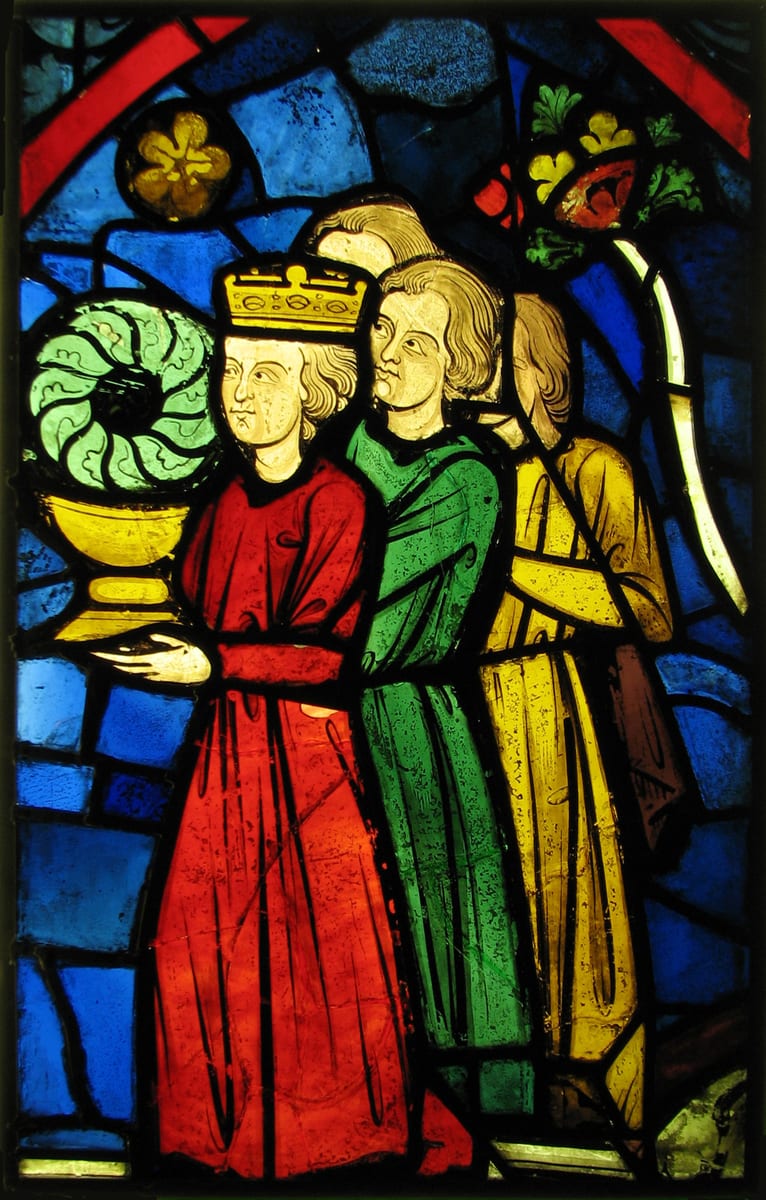
King Louis IX Carrying the Crown of Thorns, Unknown glazier (French, Tours), c. 1245–1248 AD Unknown glazier (French, Tours), The Metropolitan Museum of Art, The Cloisters Collection, 37.173.3 (pot-metal glass and vitreous paint, 55.1 × 35.4 cm; from the choir of Tours Cathedral) The Latin emperors of Constantinople had pawned the Crown of Thorns to a Venetian noble, who could sell it if the loan went unpaid. St. Louis paid off the debt and had the relic brought to France in 1239 AD. On August 18, 1239 AD, he and his brothers walked barefoot, carrying it from Vincennes to Notre-Dame.
He pulled down the old palace chapel and built the Sainte-Chapelle (*the Holy Chapel*) on the same spot. Building began in 1242 AD, and the chapel was consecrated in 1248 AD at a cost of forty thousand livres. He appointed canons and chaplains to sing the Church's daily office there for ever, and he gave them large incomes.
-
1244–1248 AD
A vow made on a sickbed
Near death at Pontoise, the king promises to go on crusade. When his mother presses him to give up the vow, he hands back the cross and then demands it again.
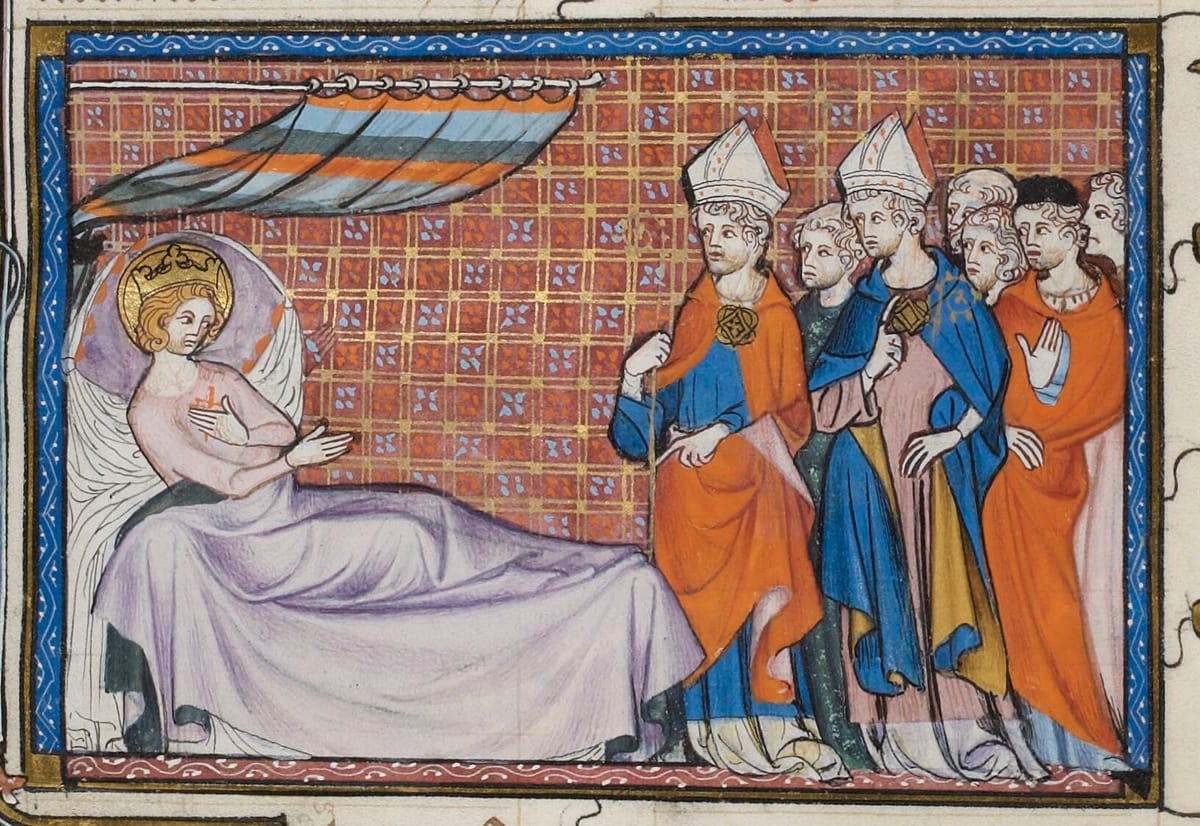
Guillaume de Saint-Pathus, Vie et miracles de saint Louis, fol. 27: Louis IX malade (the king, sick, with the cross on his breast), Paris illuminator of BnF fr. 5716 AD (attributed on Commons to Mahiet, follower of Jean Pucelle), c. 1330–1340 AD Paris illuminator of BnF fr. 5716 AD (attributed on Commons to Mahiet, follower of Jean Pucelle), Bibliothèque nationale de France, Français 5716 AD; BnF digitisation In December 1244 AD St. Louis fell gravely ill at Pontoise and lay for some days as if dead. Queen Blanche touched his body with the relics of the Cross, the Crown of Thorns and the lance. As he recovered, he asked William, bishop of Paris, to receive his vow to go on crusade to win back Jerusalem and to put the badge of the cross on his shoulder.
His mother and his counsellors argued that he had taken the cross while out of his senses. St. Louis took the cross off and handed it over, then at once demanded it back. He said he would eat nothing until he wore it again.
-
1248–1254 AD
Captured in Egypt
The crusade lands in Egypt and the king is taken prisoner. After his release he stays on in the Holy Land, where news comes that his mother has died.
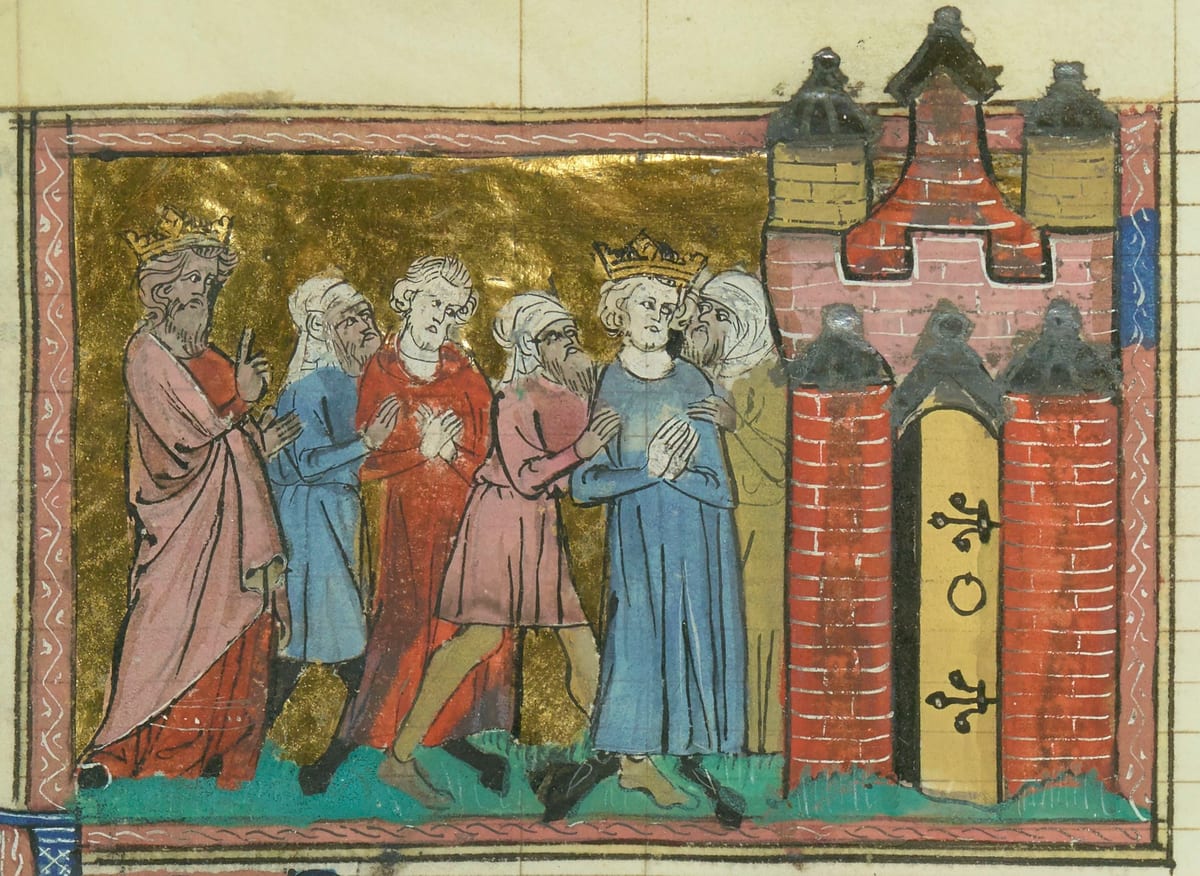
Arrestation de Louis IX (the capture of Louis IX, Grandes Chroniques de France), fol. 294v, Master of the Roman de Fauvel, 1337 AD Master of the Roman de Fauvel, Bibliothèque nationale de France, Département des manuscrits, Français 22495 St. Louis sailed in August 1248 AD, and the next year his army landed at Damietta in Egypt and took the city. In 1250 AD, as the army fell back from Mansourah, he was urged to escape by water and refused to leave his men. He was taken prisoner, and for his release he agreed to give up Damietta and to pay a ransom for his men.
He would not leave until the money was paid and the other prisoners were freed. He then stayed on in the Holy Land and fortified Jaffa and Sidon. There the news reached him that Queen Blanche, who had governed France while he was away, had died.
“Ah, seneschal, I have lost my mother!”
St. Louis IX of France to Jean de Joinville, on the news of Queen Blanche's death, at Sidon, 1253 AD -
1254–1269 AD
Judge under an oak at Vincennes
The king sails home with his family, hears cases in the open air and founds a house for the blind in Paris. He also acts against the Jews of his kingdom.
In April 1254 AD St. Louis sailed home from Acre with his wife, Queen Margaret of Provence, and their small children. After Mass he often sat against an oak in the wood of Vincennes, where anyone with a case could speak to him. In Paris he founded the Quinze-Vingts (*Fifteen Twenties*), a house for three hundred blind men.
Earlier in his reign, copies of the Talmud gathered in France with his help had been condemned and burned. On his return in 1254 AD he acted against the Talmud again, and in 1257 AD he seized all land held by Jews except their cemeteries and synagogues. By a decree of June 12, 1269 AD, he required the Jews to wear a badge.
“A-il ci nullui qui ait partie? (Is there any-one here, that has a suit?)”
St. Louis IX of France to those who came to him for judgment, sitting under an oak in the wood of Vincennes -
1267–1270 AD
Death in the camp before Tunis
The king takes the cross a second time, falls ill in the camp before Tunis and gives his son the teachings he had written for him.
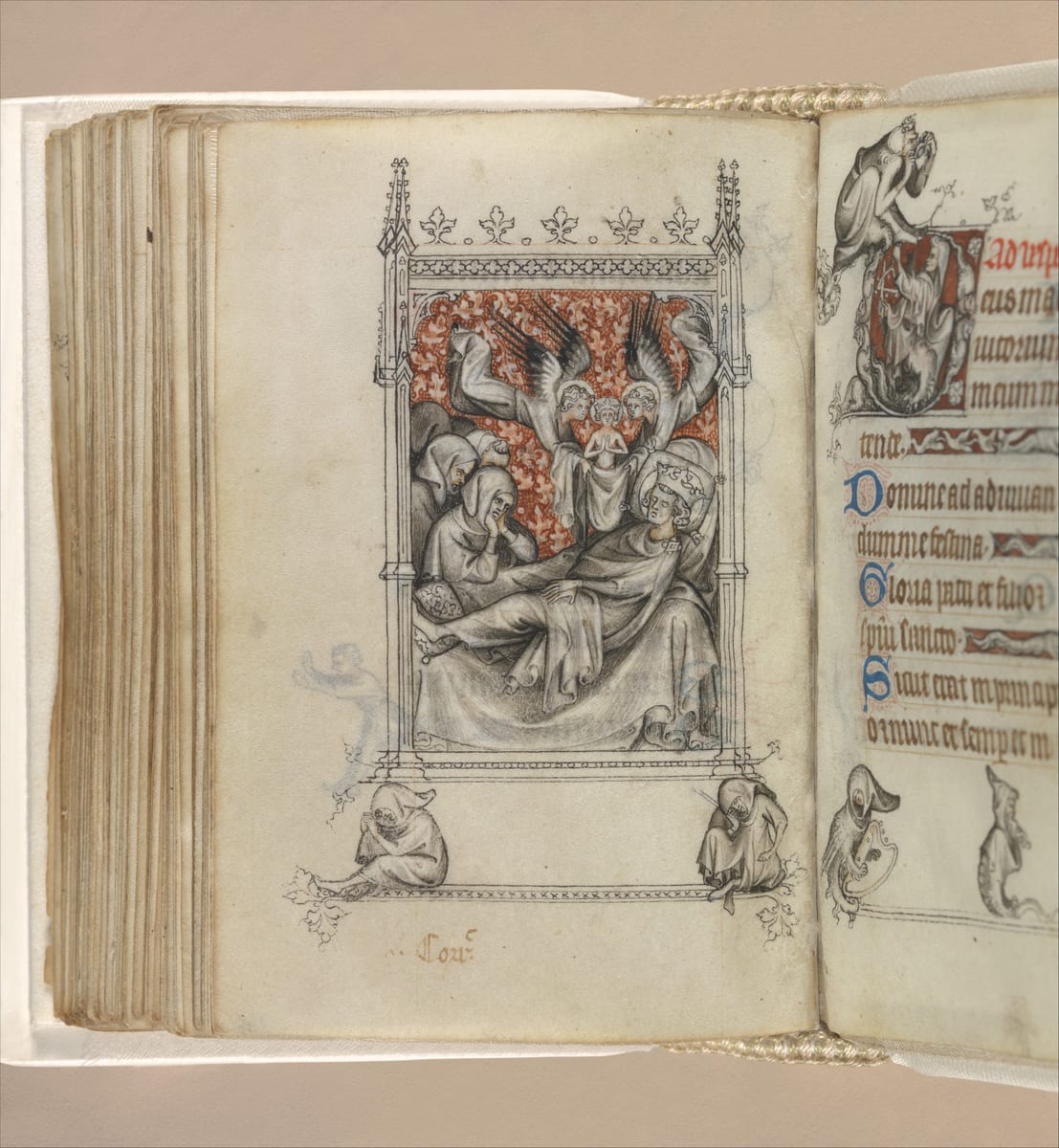
The Hours of Jeanne d'Évreux, Queen of France: the Death of Saint Louis, fol. 165v, Jean Pucelle, c. 1324–1328 AD Jean Pucelle, The Metropolitan Museum of Art, The Cloisters Collection, 54.1.2 (grisaille, tempera and ink on vellum; leaf 9.2 × 6.2 cm) In Lent 1267 AD St. Louis called his barons to Paris and took the cross a second time. He begged Joinville to come with him, and Joinville refused. A council held off Sardinia turned the fleet to Tunis, and in the camp there the king fell ill with dysentery and fever.
As his strength failed, he gave his eldest son, Philip, the teachings he had written for him, and he received the last sacraments. On August 25, 1270 AD, he could not speak from nine in the morning until noon. When his speech came back he said a verse of the psalms, and he died at about three that afternoon.
“My dearest son, my first instruction is that you should love the Lord your God with all your heart and all your strength. Without this there is no salvation. Keep yourself, my son, from everything that you know displeases God, that is to say, from every mortal sin. You should permit yourself to be tormented by every kind of martyrdom before you would allow yourself to commit a mortal sin.”
St. Louis IX of France to his son Philip, his spiritual testament, 1270 AD -
1271–1298 AD
His feast is first kept at Saint-Denis
Pope Boniface VIII canonises him in 1297 AD.
St. Louis was buried in the abbey of Saint-Denis, and miracles took place at his tomb. In 1271 AD a woman named Amelina, who had walked bent double for three years, walked upright again there. Pope Boniface VIII canonised him by a bull dated August 11, 1297 AD.
On August 25, 1298 AD, his body was taken up from its grave at Saint-Denis before the princes and prelates of France. Joinville was there, and the feast of St. Louis was kept for the first time that day.
“St. Louis, confessor, king of France, illustrious by the holiness of his life and the fame of his miracles.”
The Roman Martyrology (1916 English translation), its entry for 25 August, placed at Paris


Pray with the Church
Collect for the Memorial of Saint Louis
Roman Missal, collect of the memorial of St. Louis, August 25, in the English translation as reproduced with the readings for his memorial
O God, who brought Saint Louisfrom the cares of earthly ruleto the glory of a heavenly realm,grant, we pray, through his intercession,that, by fulfilling our duties on earth,we may seek out your eternal Kingdom.Through our Lord Jesus Christ, your Son,who lives and reigns with you in the unity of the Holy Spirit,God, for ever and ever.
All 2 reports on Saint Louis IX of France

Fearing God's rejection, young St. Louis calls the Paris scholars home
