
Saints Lawyer, Observant Franciscan and crusade preacher · Feast October 23
Saint John of Capistrano
Feast 23 October · Born 1386 AD, Capestrano, Abruzzi, Kingdom of Naples (Italy) · Died October 23, 1456 AD, Ilok (Újlak) on the Danube, Kingdom of Hungary (now Croatia)
A lawyer who governed Perugia found his vocation chained in a prison tower, preached as a Franciscan across Italy and central Europe, and died at Ilok three months after the relief of Belgrade in 1456 AD.
Begin the life
In brief
Saint John of Capistrano studied law at Perugia, and about 1412 AD King Ladislaus of Naples made him governor of the city. In 1416 AD he became an Observant Franciscan friar, and in July 1456 AD he stood with the defenders of Belgrade against the Ottoman Turks. Pope Alexander VIII declared him a saint in 1690 AD, and the Church keeps his feast on October 23, the day of his death.
-
About 1400–1416 AD
The governor who would not take gold
A boy from the Abruzzi studies law and rises to govern Perugia for the king of Naples.
St. John of Capistrano was raised in Capestrano, a town of the Abruzzi in the Kingdom of Naples. His father died when he was small, and his mother brought him up. He then spent nearly ten years at Perugia studying canon and civil law.
King Ladislaus of Naples favoured the young lawyer, and about 1412 AD made him governor of Perugia. As governor, St. John of Capistrano set himself against corruption and bribery. When a powerful man offered him a heavy weight of gold to sentence an enemy to death, he found out the truth and declared the accused innocent.
“Accidit autem, quod Potestas Perusiæ discederet a civitate, et quia diu distulit reditum, elegerunt me Perusini ejus vicarium. Unusquisque me dominum Joannem appellabat et inter alia gloriabar in cæsarie mea, quæ erat quasi filis aureis contexta, et ad morem patriæ meæ calamistrata, ita ut pulchram formam exhiberet. (Every man called me Don John, and amongst other things, I took a great pride in my hair, which was streaked with gold, and curled according to the fashion of my country.)”
St. John of Capistrano to Jacobus de Franchis, January 17, 1447 AD -
1416 AD
Chained in the tower at Brufa
Taken prisoner in a war, the governor spends months in irons and sees a vision in his cell.
Early in 1416 AD, the marriage of St. John of Capistrano to the daughter of a wealthy Perugian had been arranged. That year war broke out between Perugia and the Malatesta, and he was taken prisoner. For months he lay in a tower at Brufa near Perugia, his feet chained in forty-two pounds of iron, fed on bread and water.
As he prayed the Office of the Blessed Virgin in his chains, a man in the Franciscan habit appeared in the air and rebuked him. St. John of Capistrano said later that he was sure the friar was St. Francis, and that God wanted him to leave the world. Still a prisoner, he vowed to keep the Rule of St. Francis for the rest of his life.
“quid me vult facere Dominus? (What would God have me do?)”
St. John of Capistrano to the friar who appeared to him in prison, in a vision in the prison at Brufa, 1416 AD -
1416 AD
The mitre of sins
Freed for a ransom, the former governor gives up his bride and his goods, rides through Perugia as a public sinner and joins the friars.
His captors suspected that his change of heart was sincere, and they watched him closely. He bought his freedom for a ransom of four hundred ducats. Back in Perugia, St. John of Capistrano sold his books and clothes and gave up his bride. He urged her to vow herself to God, repaid her dowry and gave what remained to the poor.
Then he rode backwards on a donkey through the streets of Perugia, wearing a mitre painted with his sins. Children threw mud and stones at him, and people took him for a madman. On October 4, 1416 AD, the feast of St. Francis, he received the habit at Monteripido, the friary outside Perugia.
“Non ego vos decipio, neque umquam moris mei fuit simulare, sed aperte in omnibus rebus, per me gestis, procedere. (I do not deceive you, nor has it ever been my custom to act with dishonesty, but rather with sincerity in everything.)”
St. John of Capistrano to his captors, accused of feigning his conversion, 1416 AD -
1420–1450 AD
Defender of St. Bernardino
The new friar preaches, defends his teacher St. Bernardino before the Pope and works for his canonization.
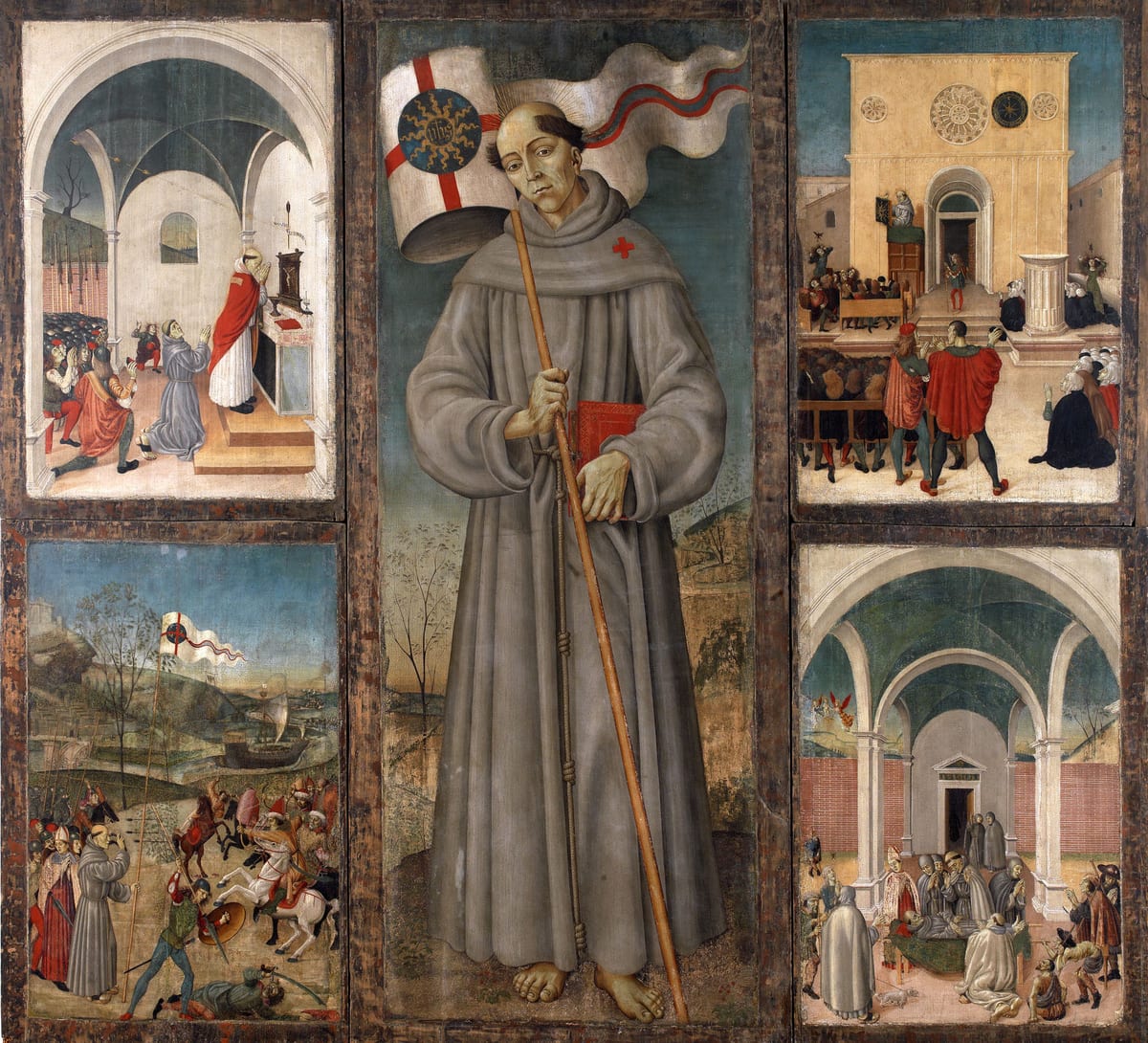
St. John of Capistrano with four stories from his life, Master of the Stories of St. John of Capistrano (Giovanni di Bartolomeo of L'Aquila?), c. 1480–1485 AD Master of the Stories of St. John of Capistrano (Giovanni di Bartolomeo of L'Aquila?), Museo Nazionale d'Abruzzo, L'Aquila; photograph by Mario Di Paolo St. John of Capistrano studied theology under St. Bernardino of Siena and began to preach in 1420 AD, while still a deacon. In 1427 AD St. Bernardino's enemies denounced his devotion to the Holy Name of Jesus to Pope Martin V as close to heresy. St. John of Capistrano defended him at a hearing in St. Peter's Basilica, and Pope Martin V concluded that hatred and envy lay behind the charges.
When St. Bernardino died in 1444 AD, St. John of Capistrano hurried to L'Aquila to work for his canonization. On May 24, 1450 AD, Pope Nicholas V declared St. Bernardino a saint. In 1450 AD Pope Nicholas V asked who would one day seek the same honour for St. John of Capistrano.
“Peccator sum, et peccatoribus talia non debentur. (I am a sinner, and to such these honours are not due.)”
St. John of Capistrano to Pope Nicholas V, asked who would work for his own canonisation, 1450 AD -
1451–1454 AD
North of the Alps
Sent into the Empire to answer the Hussites, the friar preaches across central Europe and sits as inquisitor at Breslau.
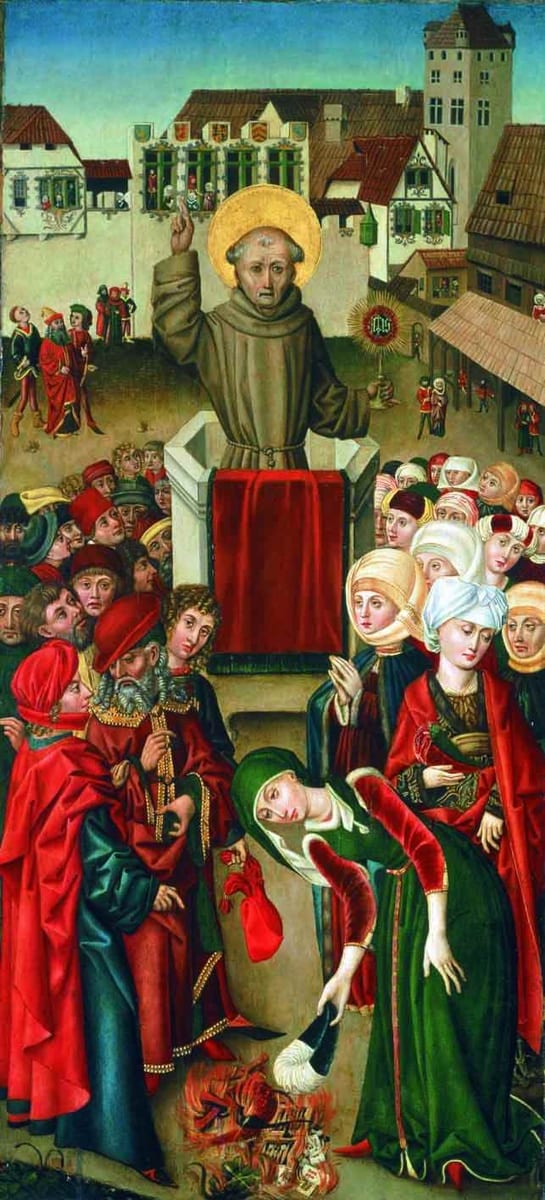
St. John of Capistrano as a preacher of penance, Unknown painter, c. 1470–1480 AD Unknown painter, Historisches Museum Bamberg Emperor Frederick III, uneasy at the spread of the Hussites, asked Pope Nicholas V to send St. John of Capistrano into the Empire. The Hussites held that Communion under both kinds was needed for salvation. He left Italy in 1451 AD, and by the following May more than eleven thousand people had formally renounced Hussite teaching before him.
At Breslau in 1453 AD, at the bishop's request, he acted as inquisitor when the Jews of the city were charged with abusing consecrated Hosts bought from a peasant. He had many of the accused arrested and tortured, and those who confessed were handed to the civil authorities for punishment. The peasant and forty-one Jews were burned, and the rest were driven out of the king's lands.
-
1453–1456 AD
Preaching the crusade
After Constantinople falls, the friar preaches war against the Turks and reaches the besieged fortress of Belgrade.
After the Ottoman Turks took Constantinople in May 1453 AD, Pope Nicholas V charged St. John of Capistrano to urge the Christian princes to take up arms. In May 1455 AD he went into Hungary, and Pope Callixtus III ordered him under obedience to stay there for the war. At Buda on February 14, 1456 AD, he wept as he received the crusade cross the Pope had sent him, and began to preach the crusade.
On July 3 the army of Sultan Mehmed II laid siege to Belgrade. On July 14 Christian ships broke the Turkish blockade on the river, and St. John of Capistrano entered the fortress with John Hunyadi, commander of the Hungarian army.
“Ego omni devotione adjecta crucem, a T. S. benedictam per manus R. D. Legati suscepi, susceptamque usque ad effusionem sanguinis, etsi centies per diem opus fuerit, servabo. (I, myself, received, from the hands of the Cardinal Legate, the cross blessed by your Holiness ; and now that I have received it, I shall wear it always, even to shedding my blood, if need be, a hundred times a day in its defence.)”
St. John of Capistrano to Pope Callixtus III, letter from Buda on taking the crusade cross, March 24, 1456 AD -
July 21–22, 1456 AD
The relief of Belgrade
At dawn the defenders of Belgrade throw back the Sultan's night assault, hurling burning bundles onto the Turks in the moats.
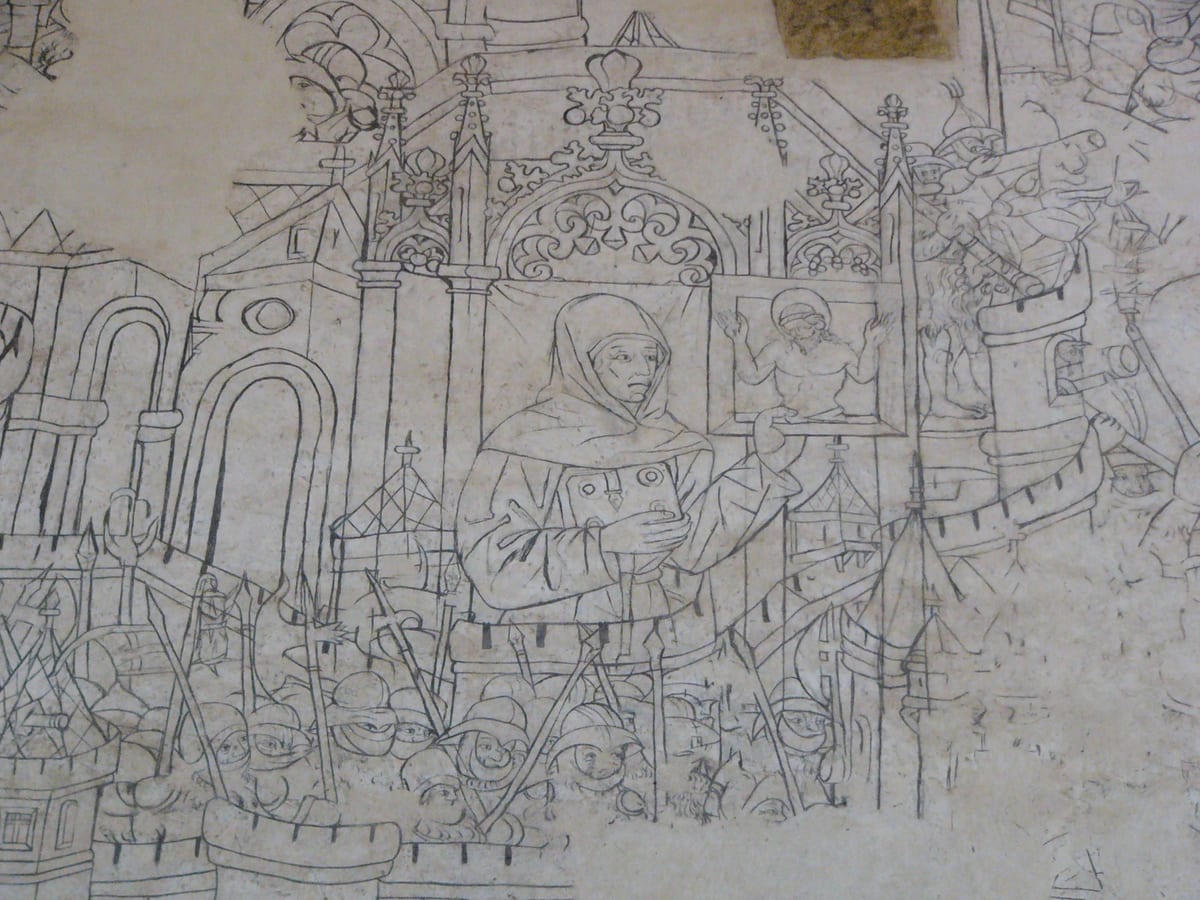
The siege of Belgrade, 1456 AD (detail), Gothic wall painting, Unknown painter, 1468 AD Unknown painter, Franciscan Church of the Immaculate Conception, Olomouc; photograph by Michal Maňas, CC BY 4.0 On the evening of July 21, Sultan Mehmed II led his janissaries in a general assault on the walls. St. John of Capistrano stood on a tower, holding up the crucifix the Pope had sent him and crying out to God. At dawn the defenders threw burning bundles onto the Turks in the moats, and the assault broke.
Later that day St. John of Capistrano crossed the Sava in a small boat. Leaning on a staff marked with the Name of Jesus, he went first against the Turkish guns, and about a thousand crusaders followed him. The Turks fled, and the siege was broken that day, July 22, the feast of St. Mary Magdalene.
“Exsultet ergo V. S. in Domino et offerre illi jubeat laudem, gloriam et honorem, quia fecit mirabilia magna solus. Non ego inermis et inutilis servus, aut pauperes et rudes crucesignati, V. S. servi, potuimus nostris viribus hæc facere. Deus Dominus exercituum fecit hæc omnia: illi gloria in sæculorum. Hæc scribo breviter et raptim, defessus, rediens ex pugna; cito scripturus magis distincte, quæ facta sunt in particulari. Ex Nanderalba, in festo S. Mariæ Magdalenæ, ipso die gloriosissimæ victoriæ. (Let your Holiness rejoice in God, and offer Him praise, glory, and honour, for He alone has done wonderful things. Neither I, poor and useless servant, nor the inexperienced Crusaders, the children of your Holiness, could have effected this by our own strength. The Lord God of armies has done all: to Him be glory throughout all ages. I write this in a hurry, returning wearied from the fight. I will soon send more particulars. From Belgrade, on the feast of St. Mary Magdalen, the day of victory.)”
St. John of Capistrano to Pope Callixtus III, letter from the battlefield, July 22, 1456 AD -
August–October 1456 AD
Death at Ilok
Sick after the battle, the friar stays with the dying commander and dies on the Danube three months after the victory.
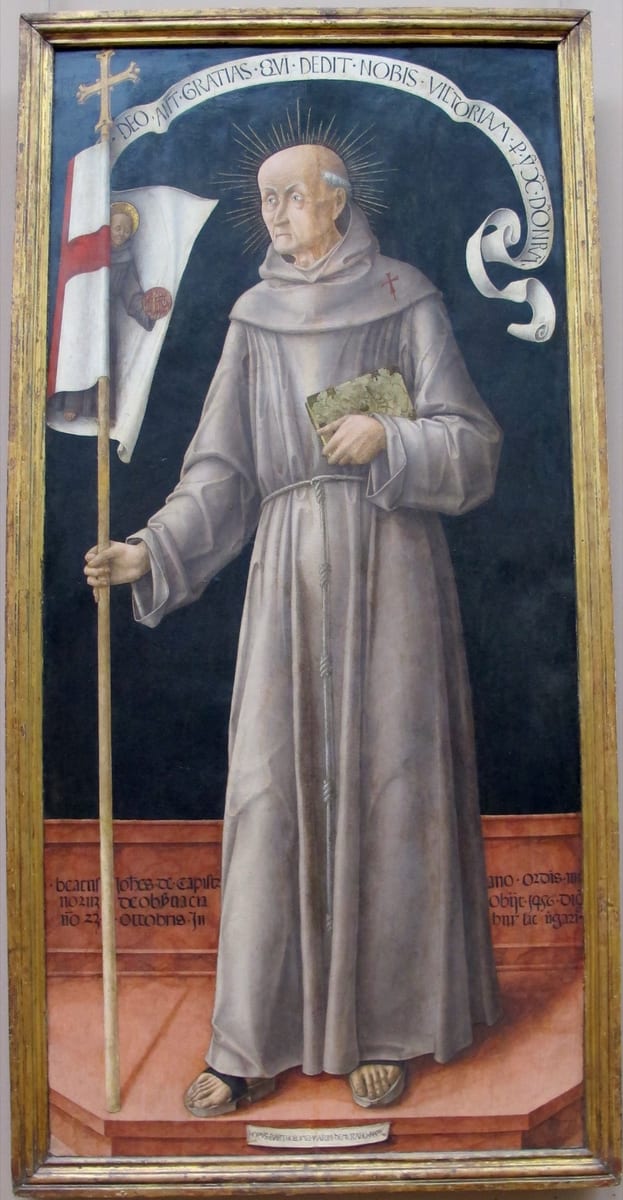
St. John of Capistrano, Bartolomeo Vivarini, 1459 AD Bartolomeo Vivarini, Musée du Louvre, Paris; photograph by Sailko, CC BY 3.0 Two weeks after the victory, St. John of Capistrano fell ill with fever in the fortress. John Hunyadi fell sick too, and St. John of Capistrano stayed with him until Hunyadi died on August 11. In his own illness he asked his companion, John of Tagliacozzo, to stay with him.
On September 1 he entered Ilok on the Danube, and he stayed there until his death. He died on Saturday, October 23, 1456 AD, about three in the afternoon, with his hands joined and his eyes raised to heaven. His body lay in the church for some days, and the whole town came to it.
“Fili, noli me derelinquere: solus sum, et neminem præter te habeo Italicum, qui mihi, forte morituro, assistat, et qui claudat oculos meos, et curet libros, mihi concessos, ad provinciam reportandos: sed patienter me sustine, et mihi assiste. Si sanus evadam, Budam simul ascendemus pro colligendis animabus. (Do not desert me, my son. I am lonely, and have no one who is an Italian but you to assist me if I am to die, to close my eyes, and to take care of the books that have been allowed to me, so that they may be taken back to the province. But bear patiently with me and help me. If I get well, we shall go together to Buda to collect men.)”
St. John of Capistrano to John of Tagliacozzo, in his illness, asking him to stay, August 1456 AD


Pray with the Church
O Christi miles inclyte (*O illustrious soldier of Christ*)
A hymn once sung in his honour, printed in Latin and English in Lives of the Saints and Blessed of the Three Orders of Saint Francis (1886 AD).
O Christi miles inclite, Joannes, voce et opere, Diebus his novissimis Clarus apparuisti. (O illustrious soldier of Christ, John, thou hast immortalised thyself, in these latter days, by thy words and works.)Tu Cruce Turcas fugas, Tu Cruce morbos sanas, Tu Cruce cunctos juvas, Dux quibus fuisti, (By the Cross, thou hast put the Turks to flight, by the Cross, thou dost expel diseases, by the Cross, thou dost help all whose leader thou wast.)Implora nobis veniam, Ac fidei constantiam, Christi legis custodiam, Quam vere dilexisti. (Implore for us forgiveness and constancy in faith, and fidelity to the law of Christ which thou didst love so much.)
All 6 reports on Saint John of Capistrano

About this picture
AI-generated image, in the manner of a fifteenth-century panel painting, from the paper's reference portrait based on St. John of Capistrano (Bartolomeo Vivarini, 1459, Musée du Louvre, Paris; photograph by Sailko, CC BY 3.0) View source artwork.
Passau crowds run over church roof to see St. John of Capistrano

About this picture
AI-generated image, in the manner of a fifteenth-century Italian panel painting, from the paper's reference portrait based on St. John of Capistrano (Bartolomeo Vivarini, 1459, Musée du Louvre, Paris; photograph by Sailko, CC BY 3.0) View source artwork.
Chained in a tower, Perugia's governor sews himself a friar's habit

About this picture
AI-generated image, in the manner of fifteenth-century panel painting, from the paper's reference portrait based on The siege of Belgrade, 1456 (detail), Gothic wall painting (Unknown painter, 1468, Franciscan Church of the Immaculate Conception, Olomouc; photograph by Michal Maňas, CC BY 4.0) View source artwork.
St. John of Capistrano waits nearly a month at Krumlov; Rokycana never comes

About this picture
AI-generated image, in the manner of a fifteenth-century Italian panel painting, from the paper's reference portrait based on The siege of Belgrade, 1456 (detail), Gothic wall painting (Unknown painter, 1468, Franciscan Church of the Immaculate Conception, Olomouc; photograph by Michal Maňas, CC BY 4.0) View source artwork.
St. John of Capistrano dies in bed at Ilok, denied a martyr's death

About this picture
AI-generated image, in the manner of a fifteenth-century pen-and-wash topographical drawing. No person appears in it.
Peasants and a friar with a staff rout Mehmed II at Belgrade

About this picture
AI-generated image, in the manner of a fifteenth-century Italian panel painting, from the paper's reference portrait based on St. John of Capistrano (Bartolomeo Vivarini, 1459, Musée du Louvre, Paris; photograph by Sailko, CC BY 3.0) View source artwork.