
Saints Empress and mother of Constantine · Feast of August 18
Saint Helena
Feast 18 August · Born 248 AD, Drepanum, Bithynia — modern Hersek, Turkey · Died 330 AD, the imperial court, in the eastern Roman Empire
Born of humble parents in Bithynia, she was made Augusta by her son the emperor, and in her eightieth year she went to Jerusalem.
Begin the life
In brief
Saint Helena, also called Helena of Constantinople, was born of humble parents at Drepanum in Bithynia about the middle of the third century. She bore one son, Constantine, who became emperor and raised her to the rank of Augusta. In her eightieth year St. Helena travelled to Jerusalem, cleared the ground over the tomb of Christ and built churches in the Holy Land.
-
Drepanum and Naissus, 248–292 AD
A woman of a village of no consequence in Bithynia
She came from a village of no consequence, bore a son to a Roman officer, and was set aside when he rose.
St. Helena was born about the middle of the third century at Drepanum, on the Nicomedian Gulf. St. Ambrose called her a stabularia, an inn-keeper. Procopius records that the people of Bithynia said she was born in that village.
Her only son, Constantine, was born at Naissus in Upper Moesia in 274 AD. His father was Constantius, a Roman officer who later became emperor. In 292 AD Constantius was made co-Regent of the West and forsook her to marry Theodora.
-
The imperial court, 306–324 AD
Augusta, and her face on the coinage
Sixteen years after she was set aside, her son took the empire and called her to court.
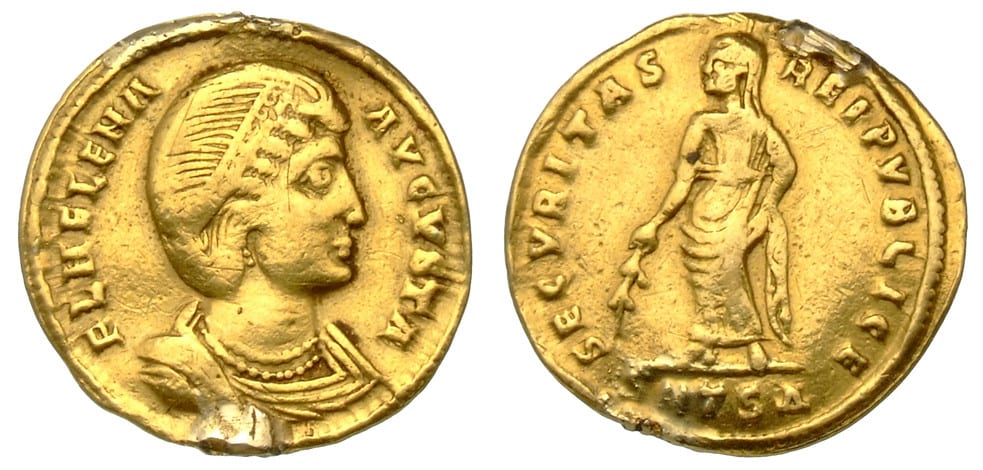
Nummus of Helena Augusta, Thessalonica mint, RIC VII 134 AD — obverse FL HELENA AVGVSTA, reverse SECVRITAS REIPVBLICE, Imperial mint of Thessalonica. Photograph by Reinhard Saczewski, struck 324 AD Imperial mint of Thessalonica. Photograph by Reinhard Saczewski, Münzkabinett, Staatliche Museen zu Berlin (inv. 2365120) In 306 AD the troops at York proclaimed Constantine the successor of his father. Constantine summoned his mother to court and conferred on her the title of Augusta. Her likeness was struck on golden coins, and the soldiers in every province named her empress.
Constantine gave her authority over the imperial treasures, to spend at her own discretion. St. Helena embraced Christianity after her son's victory over Maxentius at Rome in 312 AD.
“She (his mother) became under his (Constantine's) influence such a devout servant of God, that one might believe her to have been from her very childhood a disciple of the Redeemer of mankind.”
Eusebius of Caesarea, describing Helena's Christian devotion, Vita Constantini III, xlvii -
The imperial court, 326 AD
The charge against Crispus
The emperor killed his son, and learned too late from his mother that the accusation was false.
In 326 AD Constantine ordered the execution of his son Crispus. The charge was false, and the emperor learned it from his mother after the deed was done. In the same year he put his wife Fausta to death.
-
Jerusalem, 324–326 AD
The tomb under the temple
An empress of about eighty crossed to Palestine and ordered the ground at Golgotha stripped.
After her son defeated Licinius, St. Helena undertook the journey to Palestine despite her age. She came to Jerusalem in her eightieth year and found the city desolate.
A temple to Venus stood over the buried tomb of Christ. Theodoret records that she ordered the temple destroyed and the earth beneath it removed. The tomb, concealed for generations, was uncovered.
“The grace of our Saviour is so wonderful, that no words are adequate to express the present marvel.”
Constantine to Macarius, Bishop of Jerusalem, letter concerning the building of the Holy Church over the Holy Sepulchre -
Mount Calvary, 326 AD
Three crosses, and one of them the Lord's
According to longstanding Catholic tradition, St. Helena found the three crosses at Calvary.
According to longstanding Catholic tradition, three crosses were found buried near the sepulchre. Tradition holds that Saint Macarius, bishop of Jerusalem, sought a sign from God to tell them apart. Socrates, Sozomen and Theodoret record that a dying woman was touched with each cross and healed by the third.
The same historians hold that St. Helena left part of the wood at Jerusalem in a silver case. Tradition holds that she sent the rest to her son, with the nails found beside it.
“Today, Constantine and his mother reveal the cross, * that most precious tree which puzzles the Jews. * It is the armor of Christian authorities against enemies. * It has proved itself awesome in war by its many miracles.”
the Church (Kontakion, Tone 3), Kontakion for the feast of Constantine and Helen -
Bethlehem and the Mount of Olives, 326–333 AD
Two churches over two caves
She built at the place of the birth and at the place of the ascent, and travellers found both standing.
Eusebius records that she dedicated a church at the grotto where the Saviour was born. She raised a second church on the summit of the Mount of Olives. Constantine added silver, gold and embroidered hangings to his mother's church at Bethlehem.
A pilgrim from Bordeaux found both basilicas standing in 333 AD.
-
The eastern provinces, 326 AD
Money, clothing and freedom
On the road east she emptied the treasury she had been given, and at Jerusalem she waited at table.
On a circuit of the eastern provinces she gave money to some and clothing to others. She freed prisoners, took men out of the mines and brought others back from exile.
Eusebius records that she stood in plain dress among the crowd of worshippers. At Jerusalem she seated the consecrated virgins at table and served them herself.
-
The imperial court and Rome, 330 AD
Her will, and her son's hands
She died at eighty with the emperor beside her, and the Church keeps her day at the road where she was buried.
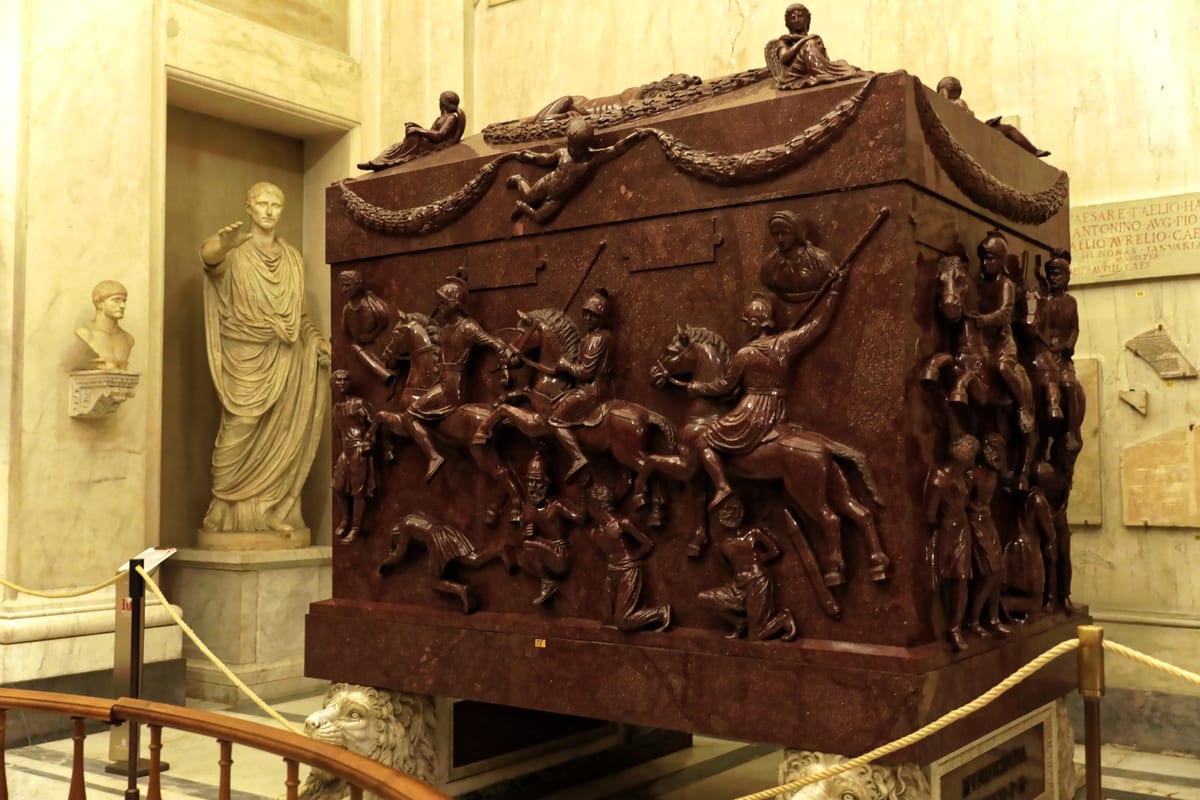
Sarcophagus of St. Helena, Unknown Roman workshop; restored in 1777-1778 AD by Gaspare Sibilia and Giovanni Pierantoni, on four lions carved by Francesco Antonio Franzoni. Photograph by Burkhard Mücke, c. 310-320 AD; brought to the Vatican 1777 AD. Photograph October 18, 2017 AD Unknown Roman workshop; restored in 1777-1778 AD by Gaspare Sibilia and Giovanni Pierantoni, on four lions carved by Francesco Antonio Franzoni. Photograph by Burkhard Mücke, Musei Vaticani, Museo Pio Clementino, Sala a Croce Greca (cat. 238), Vatican City In her eightieth year St. Helena made her will in favour of her son and her grandsons. She died with the emperor at her side, caring for her and holding her hands.
Eusebius records that a vast train of guards escorted her body to a royal tomb. The Book of the Popes records that Constantine buried her in a porphyry sarcophagus on the Via Labicana. The Roman Martyrology commemorates her there on August 18.


Pray with the Church
Troparion of Saints Constantine and Helen, Tone 8
The troparion of the feast of Saints Constantine and Helen, kept on May 21 in the Byzantine churches, from the Menaion of the Byzantine Catholic Archeparchy of Pittsburgh. The asterisks of the chant divisions are set here as line breaks.
Seeing the cross in the sky like Paul,like him you received a call from the Divine.You committed the royal city into the hands of the Lord.Save this city always in peace, O only Lover of us all,through the prayers of the Theotokos.
All 3 reports on Saint Helena

About this picture
AI-generated image, in the manner of a late-Roman fresco of the Constantinian decades, from the paper's reference portrait based on Seated statue of Helena of Constantinople — head (Unknown Roman sculptor; head recut in the Constantinian period on an Antonine body. Photograph by Jebulon, body: second half of the 2nd century AD; head: Constantinian, c. 306-337 AD, Musei Capitolini, Rome) View source artwork.
.jpg)
Saint Helena, at eighty, orders a temple demolished and uncovers Christ's tomb

About this picture
AI-generated image, in the manner of a late-Roman fresco of the Constantinian decades, from the paper's reference portrait based on Christ enthroned between the apostles Peter and Paul, with the Lamb on the hill of the four rivers and the martyrs Gorgonius, Peter, Marcellinus and Tiburtius (Unknown Roman painter, 4th century AD, Catacomb of Saints Marcellinus and Peter, Via Labicana, Rome) View source artwork.

Jerusalem dedicates the church at Calvary and the church over Christ's tomb

About this picture
AI-generated image, in the manner of a late-Roman fresco of the Constantinian decades, from the paper's reference portrait based on Seated statue of Helena of Constantinople — head (Unknown Roman sculptor; head recut in the Constantinian period on an Antonine body; photograph by Jebulon, body: second half of the 2nd century AD; head: Constantinian, c. 306-337 AD, Musei Capitolini, Rome) View source artwork.