
Saints Founder of the Order of Preachers · about 1170–1221 AD
Saint Dominic
Feast 8 August · Born 1170 AD, Caleruega, Old Castile, Spain · Died 1221 AD, Convent of San Niccolò, Bologna, Italy
A Castilian who sold his student books to feed the starving became a priest, preached on foot for years in the south of France, founded the Order of Preachers and died among his friars at Bologna in 1221 AD.
Begin the life
In brief
Saint Dominic, also called Dominic de Guzmán, was a Castilian priest who founded the Order of Preachers. The Order's Constitutions say it was founded chiefly for preaching and for the salvation of souls. Pope Gregory IX canonized him in 1234 AD, thirteen years after his death at Bologna.
-
about 1170–1184 AD
A boy from Caleruega
St. Dominic was born into a noble Castilian family and left home at seven to be taught by his uncle, a priest.
St. Dominic was born about 1170 AD at Caleruega, a village in Old Castile, Spain, to Felix and Blessed Joanna of Aza, of a noble Castilian family. According to longstanding Catholic Tradition, before he was conceived his mother saw in a vision that she carried a puppy holding a burning torch in its mouth. The Roman Breviary reads the vision as a sign that his holiness and teaching would stir whole nations to Christian devotion.
At seven, St. Dominic left home to be taught by his mother's brother, the archpriest of Gumiel de Izán. He studied under his uncle until he was fourteen.
-
1184 AD–1190s AD
Books sold in a famine
As a student he sold his annotated books and his furniture to feed the poor of Palencia.
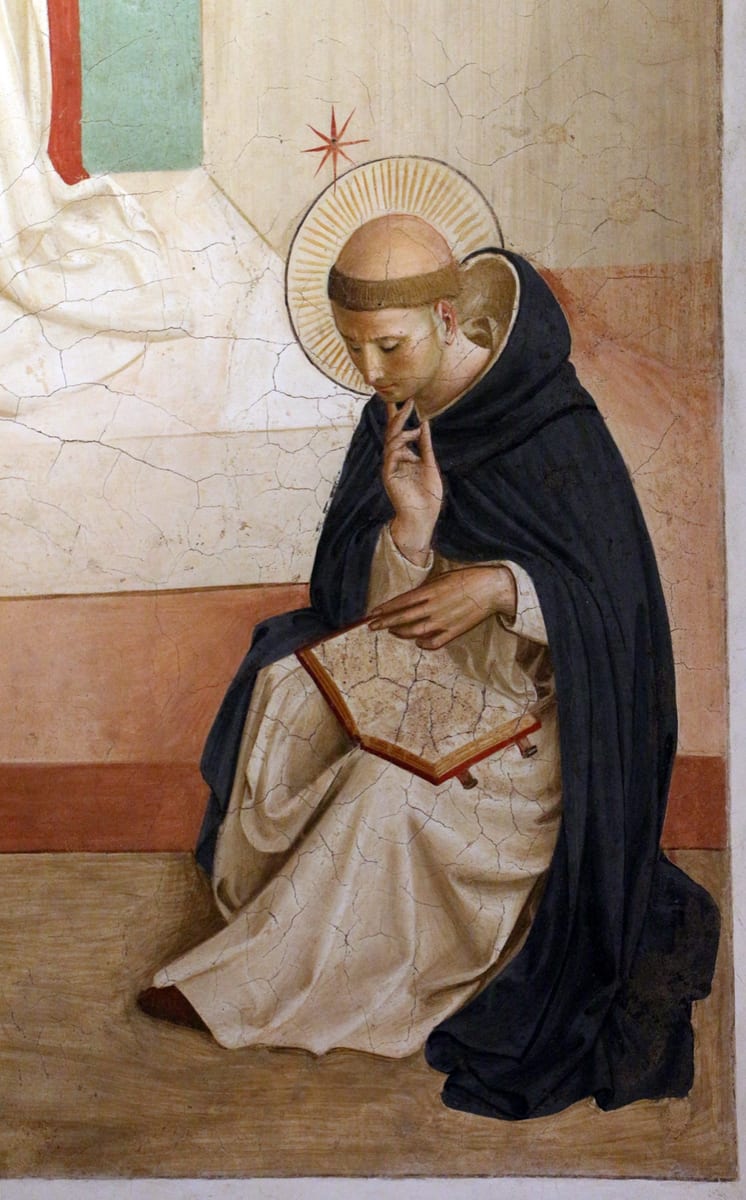
Mocking of Christ (detail: St. Dominic reading), Cell 7, Fra Angelico and assistants, c. 1438-1440 AD Fra Angelico and assistants, Museo di San Marco, Florence In 1184 AD, in his fifteenth year, St. Dominic went to the schools of Palencia. He stayed ten years, six in arts and philosophy and four in theology, and studied so hard that he went short of sleep.
While he was still a layman there, a severe famine struck all of Spain. St. Dominic sold his books, which carried notes in his own hand, along with his clothes and furniture, and gave the money to the poor. He set up a place where the hungry could be fed, and other teachers at Palencia followed his example and gave much more generously.
“Nolo studere super pelles mortuas, et homines moriantur fame. (How can I study from dry parchments when there are human beings dying of hunger?)”
St. Dominic to those who wondered that he had sold his books, in the famine at Palencia, while still a student -
1190s–1203 AD
A night at Toulouse
Travelling north with his bishop, the young canon of Osma talked their heretic host back to the Catholic faith in one night.
St. Dominic was ordained a priest and became a canon of the cathedral of Osma, his home diocese, where Diego de Azevedo was prior. The canons made St. Dominic their subprior, the prior's deputy, though he was the youngest of them.
In 1203 AD the King of Castile sent Diego, by then Bishop of Osma, north to seek a bride for his son, and the bishop took St. Dominic with him. At Toulouse their host turned out to be an Albigensian, one of a sect teaching that two equal powers, one good and one evil, made the world. St. Dominic talked with him through the night, and before morning the man returned to the Catholic faith.
-
1204–1207 AD
Sent to Languedoc
The Pope turned down a mission to a distant people and sent St. Dominic to preach in the south of France instead.
Towards the end of 1204 AD, Bishop Diego and St. Dominic reached Rome. Bishop Diego wanted to resign his diocese and preach to the Cumans, who were not Christian, and St. Dominic often said he wanted to go to them too. Pope Innocent III refused and sent them to Languedoc, in the south of France, to preach to the Albigensians.
At Montpellier Bishop Diego sent his horses and servants back to Spain, and he and St. Dominic went on to preach on foot and in poverty. In 1206 AD St. Dominic began his first foundation, at Prouille, a house for women converts. In 1207 AD he walked with Bishop Diego to the edge of Languedoc, preaching on the way, and the two friends parted there; Bishop Diego died before the year was out.
-
1208–1215 AD
Preaching through a war
After one of the Pope's legates was murdered, war came to Languedoc. St. Dominic kept preaching, turned down a bishopric and prayed through a battle.
In 1208 AD one of the Pope's legates against the heresy was murdered near the Rhône, and a crusade against the Albigensians followed. St. Dominic stayed on in the province and kept preaching, though heretics spat at him and threw mud at him, and he said he was not worthy to die a martyr. Catholic Tradition holds that in these years of preaching Our Lady gave St. Dominic the Rosary, and Pope Leo XIII wrote in 1883 AD that St. Dominic used it as a remedy against the heresy of his time.
In July 1212 AD the cathedral clergy of Béziers chose St. Dominic as their bishop, and he refused. In September 1213 AD he was inside the small fortress of Muret with Simon de Montfort, the crusade's military leader, and prayed with the bishops and monks while the crusaders broke out and routed a far larger army.
-
1215–1217 AD
An order confirmed and sent out
A bishop named St. Dominic and his companions preachers, the Pope confirmed their order, and he sent his few friars out across Europe.
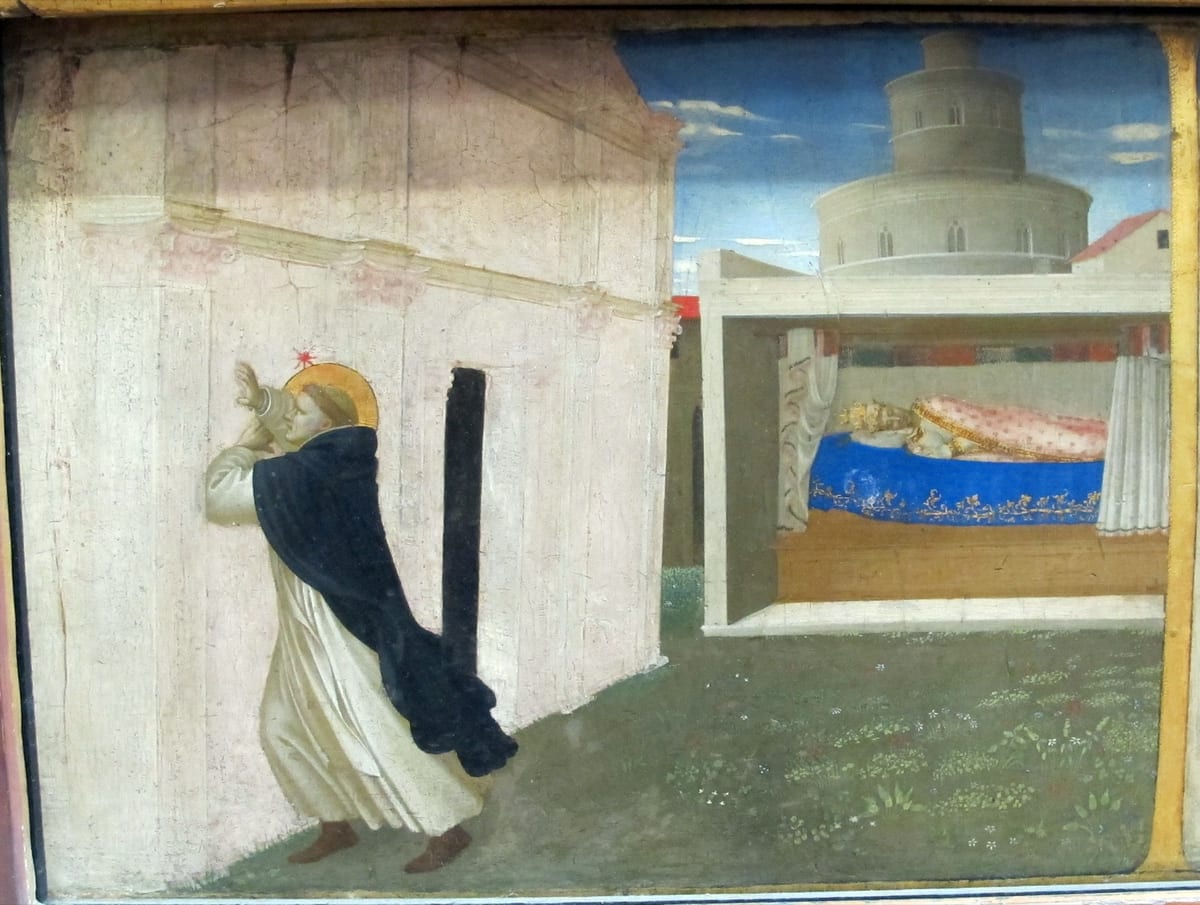
Coronation of the Virgin, predella: the Dream of Pope Innocent III, Fra Angelico, c. 1430-1432 AD Fra Angelico, Musée du Louvre, Paris (INV 314 AD; from San Domenico, Fiesole) In 1215 AD Bishop Fulk of Toulouse named St. Dominic and his companions preachers for his diocese, men who had resolved to go on foot in the poverty of the Gospel and preach it. St. Dominic went to Rome with Bishop Fulk to ask Pope Innocent III to confirm the order he had founded. As Catholic Tradition tells it, while the request was undecided the Pope dreamed that the Lateran basilica was falling and that St. Dominic held it up on his shoulders.
Pope Innocent III sent St. Dominic back to his brothers to choose a rule for themselves, and on December 22, 1216 AD, Pope Honorius III confirmed the Order of Preachers in two papal letters addressed to St. Dominic. In 1217 AD he sent his friars out to preach in Paris, Spain and Bologna, with no money, begging their way. Count Simon de Montfort, the Archbishop of Narbonne and Bishop Fulk urged him to keep his small community together, and he refused.
“The seed will fructify if it is sown; it will but moulder if you hoard it up.”
St. Dominic to the brethren and the prelates, announcing the dispersal of the brethren, 1217 AD -
1219–1220 AD
An order gives up its property
Once settled at Bologna, St. Dominic tore up a gift of land and led the friars' first general meeting to give up all property.
St. Dominic reached Bologna in the summer of 1219 AD, and the city was his home for the rest of his life. In front of the bishop, he tore up a deed giving the friars valuable lands, because he wanted his sons to beg their daily bread.
On May 17, 1220 AD, the friars met at Bologna for their first General Chapter. At St. Dominic's proposal, the Order gave up all its property for good and resolved to live on daily alms. He also offered to resign as its head, but the friars refused and confirmed him as Master General.
“I deserve to be deposed, for I am unprofitable and useless.”
St. Dominic to the fathers of the General Chapter, at the first General Chapter at Bologna, May 1220 AD -
July–August 1221 AD
Death at Bologna
Worn out from a journey, St. Dominic fell ill with fever and died among his friars at noon on August 6, 1221 AD.
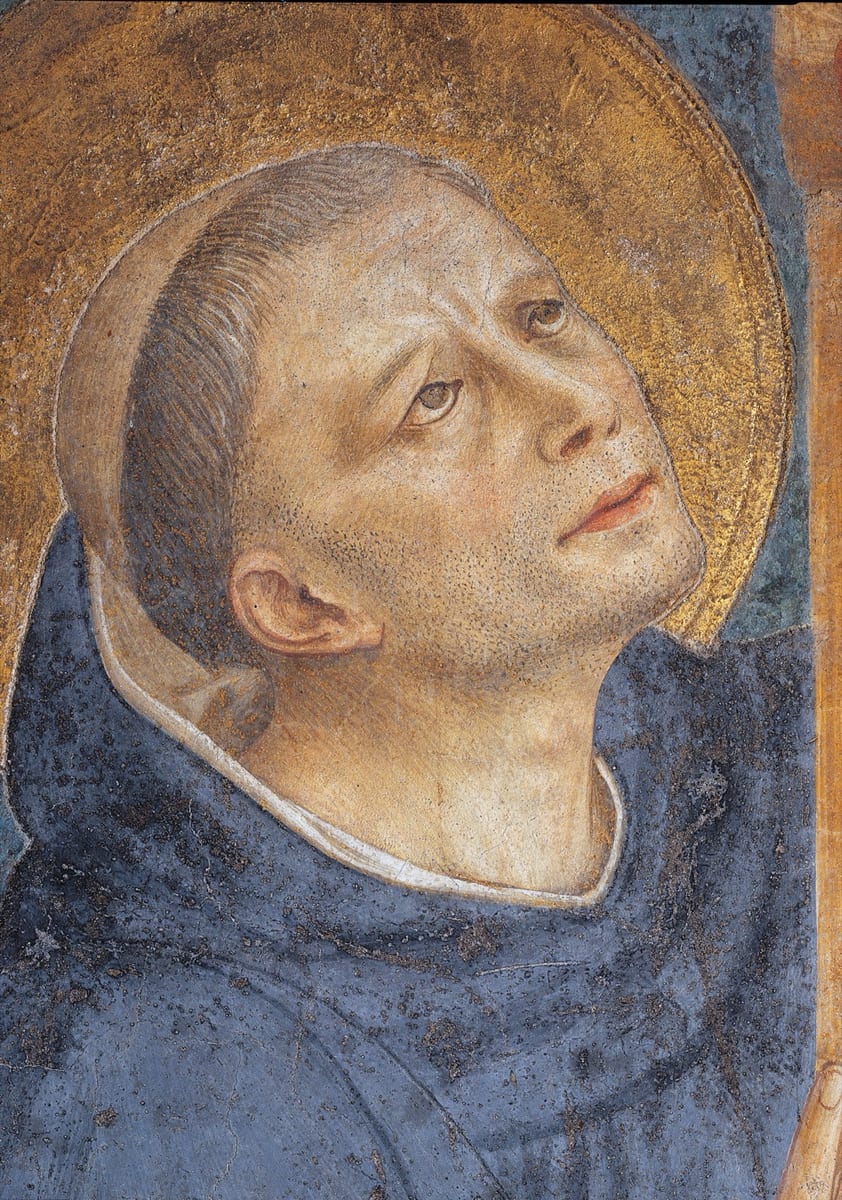
Saint Dominic adoring the Crucifixion (detail, head of St. Dominic), Fra Angelico, c. 1442-1445 AD Fra Angelico, Museo di San Marco, Florence (cloister of Sant'Antonino) Late in July 1221 AD, St. Dominic came back to Bologna from Venice exhausted and spent the night in prayer. After the night office he told Friar Ventura, the prior at Bologna, that he had a headache, and fever and dysentery followed. The friars carried him to a church on a hill for cooler air, but when he learned he might be buried there, he asked to be brought back so that he could be buried under his friars' feet in their own church.
He called his brothers together and left them charity, humility and poverty as their inheritance. When the friars wept, he told them he would be of more use to them after his death than he had been in life. He raised his hands and prayed for them to the Father, and he died at noon on Friday, August 6, 1221 AD.
“Under the feet of my brethren.”
St. Dominic to a brother who asked where he wished to be buried, on his deathbed at Bologna, August 1221 AD


Pray with the Church
St. Dominic's last prayer for his brothers
The friars testified at the canonization inquiry that St. Dominic prayed these words with his hands raised as he lay dying at Bologna on August 6, 1221 AD. The English is from Henri-Dominique Lacordaire's Life of Saint Dominic (1883 AD).
Holy Father, I have accomplished Thy will, and those whom Thou hast given me I have kept; I now commend them unto Thee.Do Thou preserve and keep them.
All 1 report on Saint Dominic
