
Saints Martyr of Lycia · third century AD
Saint Christopher
Feast 25 July · Born 200 AD, Canaan (traditional; no source gives an identifiable modern location) · Died 250 AD, Lycia, Asia Minor (modern Turkey)
In Catholic Tradition, a strong man who would serve only the strongest lord carried Christ across a river; the Church names him a martyr of Lycia.
Begin the life
In brief
According to longstanding Catholic Tradition, Saint Christopher carried travellers across a deadly river, and one child he carried was Christ. The Roman Martyrology enters him under July 25 as a martyr who died in Lycia in the time of the emperor Decius.
-
Third century AD
A king's son called Reprobus
Tradition makes St. Christopher a heathen king's son in Canaan, very large and strong, first named Reprobus, meaning rejected.
In Catholic Tradition, St. Christopher was born in Canaan, the son of a heathen king. His father dedicated him to the gods Machmet and Apollo, and he grew very large and strong. Before his baptism he was called Reprobus, Latin for rejected; afterwards he was St. Christopher, a name that is Greek for Christ-bearer.
Eastern Tradition holds that St. Christopher was very handsome, and that he asked the Lord for an unattractive face to spare himself and others temptation, and the Lord granted it. The Byzantine liturgy still sings that he was terrifying in strength and in face.
-
Third century AD
The search for the greatest king
Tradition holds that St. Christopher left a king, then the devil, each time because his master feared someone stronger.
According to Catholic Tradition, St. Christopher resolved to serve only the greatest and strongest lord in the world. He entered the court of a king famed as the greatest on earth, who was a Christian. When a minstrel sang of the devil, the king made the sign of the cross, and St. Christopher demanded to know why.
The king said he feared the devil's power, so St. Christopher left him to seek the devil as the stronger lord. In a desert a cruel knight told him he was the devil, and St. Christopher bound himself to serve him for life. But the devil fled from a cross by the road and admitted he feared Christ, so St. Christopher left him to seek Christ.
-
Third century AD
The hermit and the river
Tradition holds that because St. Christopher could not fast or pray, a hermit gave him other work: carrying people across a river.
In the same Tradition, St. Christopher at last found a hermit in the desert, who taught him about Christ. Told that Christ's service meant frequent fasting, he said he could not fast. Told to keep watch at night and pray often, he said he did not know what that was.
Instead, the hermit sent him to a river where many had drowned, to carry across everyone who came. A man so tall and strong, the hermit told him, would please Christ with this work, and Christ might show himself to him. St. Christopher promised, built a small dwelling on the bank and for many days carried people across, leaning on a great pole.
-
Third century AD
The crossing
Tradition holds that the child St. Christopher carried grew heavy as lead in midstream, and on the far bank said who he was.
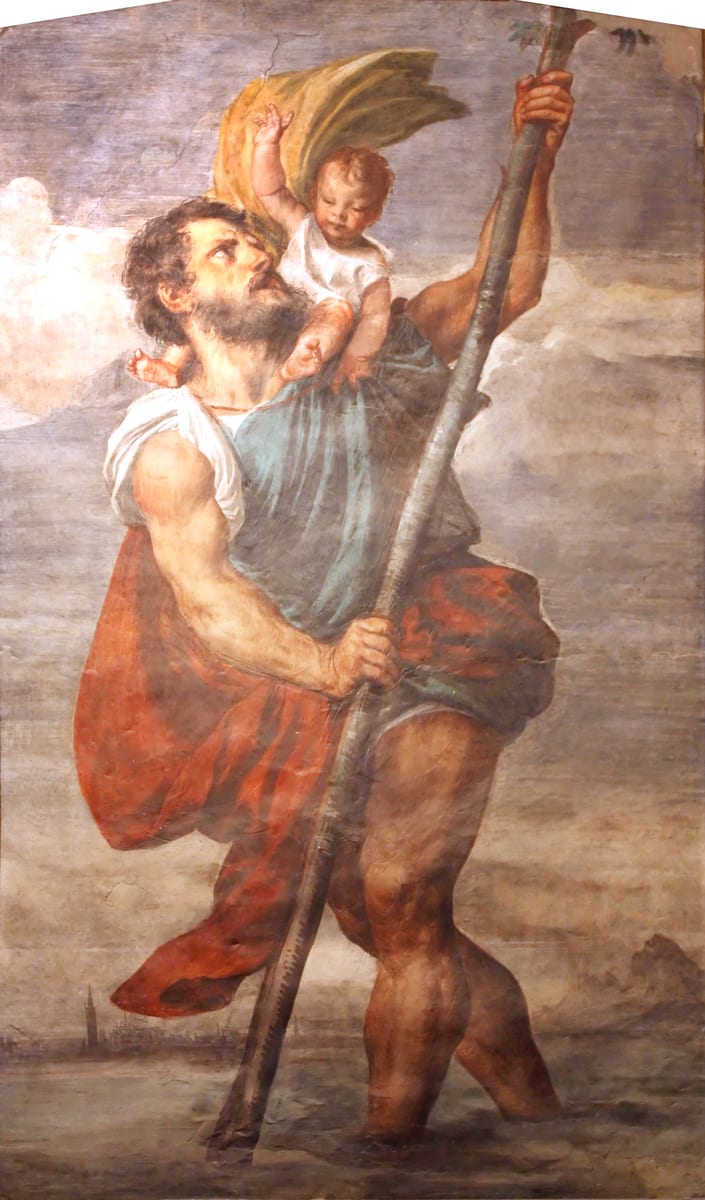
San Cristoforo (Saint Christopher carrying the Christ Child), Titian (Tiziano Vecellio, 1490-1576 AD), 1523-1524 AD Titian (Tiziano Vecellio, 1490-1576 AD), Palazzo Ducale (Doge's Palace), Venice; fresco, 310 x 186 cm As Catholic Tradition tells it, a child's voice woke St. Christopher three times, and at the third call he found a child on the bank. He lifted the child onto his shoulders and waded in with his staff. The river rose and the child grew heavy as lead, until St. Christopher was afraid he would drown.
On the far bank he set the child down and told him he had felt as if he were carrying the whole world. The Child answered that St. Christopher had carried the maker of the world, and named himself Jesus Christ the king. Then the Child told him to plant his staff beside his house, and vanished; St. Christopher planted it, and next morning it stood as a palm with flowers, leaves and dates.
-
c. 250 AD
Lycia
Tradition holds that St. Christopher saw thousands converted in Lycia and let the king's knights lead him away bound.
Catholic Tradition holds that St. Christopher then went to the city of Lycia, prayed to understand its language, and was given it. He went to the place where Christians were being put to death and comforted them. He planted his staff and prayed that it would flower for the people's conversion; it did, and thousands were converted.
Dagnus, the king of Lycia, sent two knights to fetch him, but they found him praying and did not dare tell him why they had come. The king sent as many again, and these sat down to pray with him; when they offered to let him go, he refused and had them bind his hands. Before the king he refused gifts and honours offered for sacrifice to the gods, and was sent to prison.
-
c. 250 AD
Fire, arrows and the sword
The Roman Martyrology records that St. Christopher was scourged, cast into the flames, shot with arrows and beheaded; Tradition holds that his blood healed the king who ordered it.
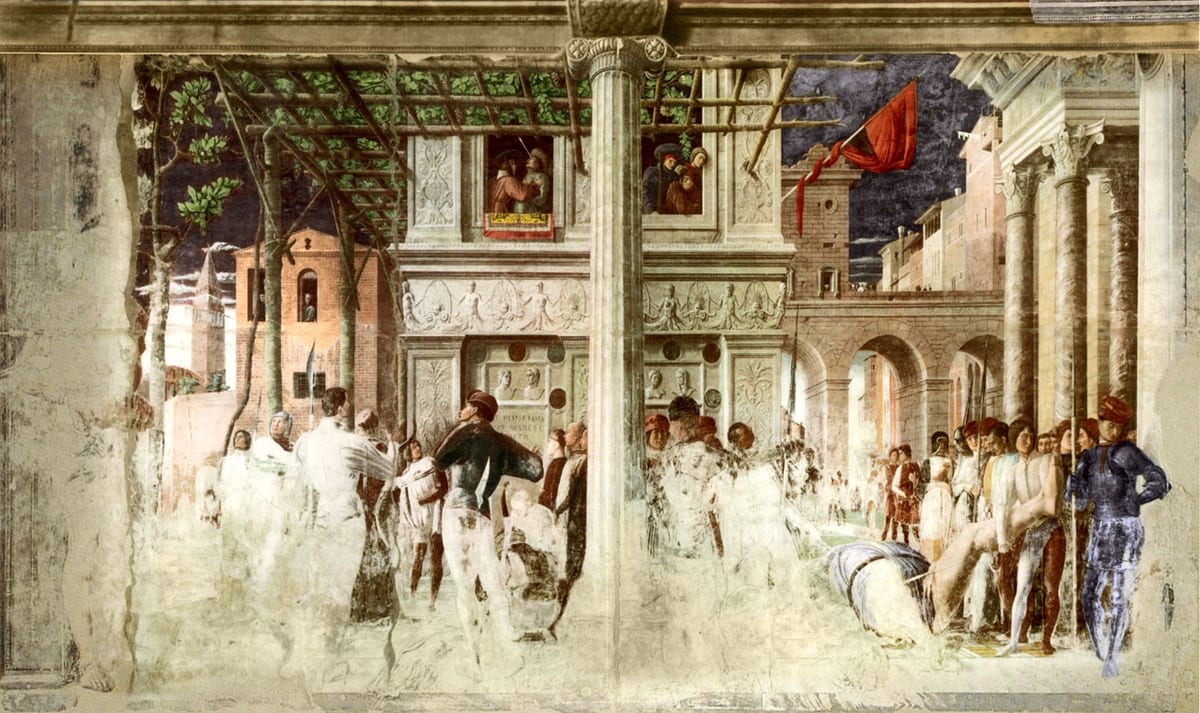
Martirio e trasporto del corpo decapitato di san Cristoforo (The martyrdom and the carrying away of the decapitated body of St Christopher), bottom register of the St Christopher wall, Ovetari Chapel, Andrea Mantegna (1431-1506 AD), 1447-1456 AD Andrea Mantegna (1431-1506 AD), Cappella Ovetari, Church of the Eremitani, Padua; fresco, 664 cm wide (destroyed by bombing in 1944 AD) In longstanding Catholic Tradition, St. Christopher was bound on an iron seat over a fire, and the seat melted like wax. Forty archers shot at him as he stood bound to a stake, but the arrows hung in the air around him. One arrow turned back and struck the king in the eye, blinding him.
St. Christopher told the king to wait until he was dead, then anoint the eye with clay mixed with St. Christopher's blood. He was led out, made his prayer and was beheaded. The king laid a little of the martyr's blood on his eye, was healed at once and believed in God.
“In Lycia, in the time of Decius, St. Christopher, martyr. Being scourged with iron rods, cast into the flames, from which he was saved by the power of Christ, and finally transfixed with arrows and beheaded, he completed his martyrdom.”
The Roman Martyrology -
527–1904 AD
Painted where nobody could miss him
Churches painted St. Christopher larger than life, because a look at his image was believed to bring a blessing.
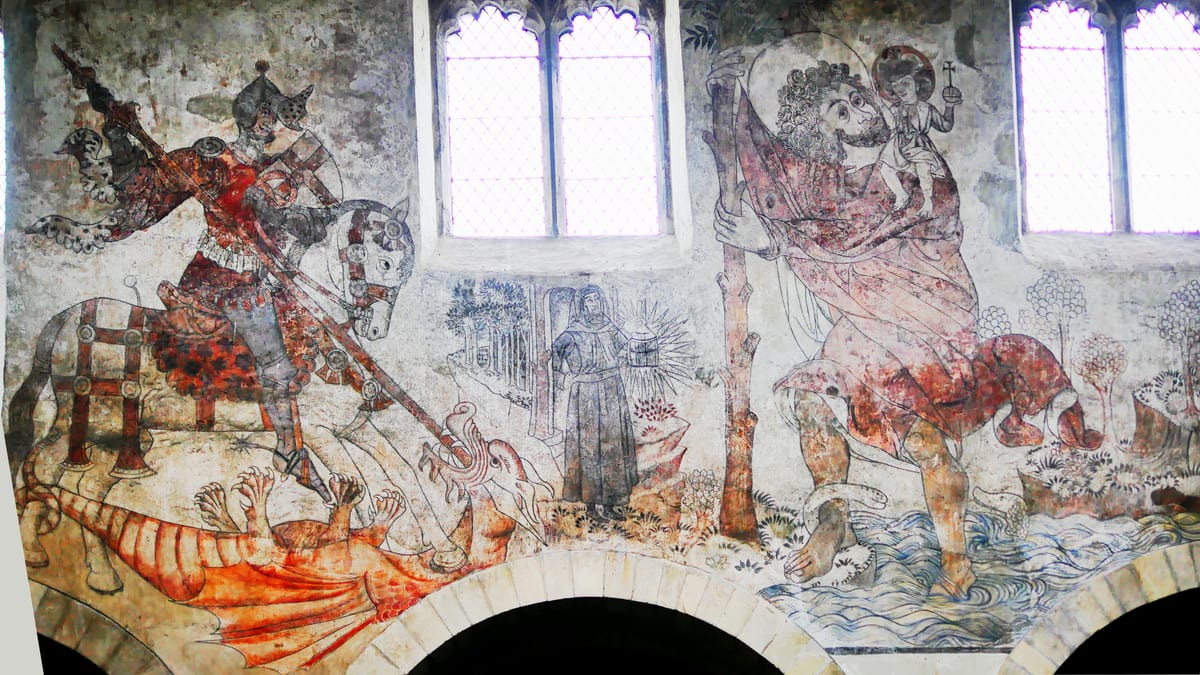
Medieval wall paintings of St Christopher and St George, north wall, Unknown English wall painter, 15th century AD Unknown English wall painter, Church of Saints Peter and Paul, Pickering, North Yorkshire, England; photograph by Helge Klaus Rieder, 2017 AD By the sixth century St. Christopher was honoured both in the East and in the West. The oldest picture of St. Christopher, at the monastery on Mount Sinai, dates from the time of Justinian, 527–565 AD. In 532 AD the body of St. Remigius of Reims was buried in a small church dedicated to St. Christopher.
Pilgrims who looked at his image were believed to gain a special blessing. So from the thirteenth century many churches painted him huge, on prominent inside walls or outside, where no pilgrim could miss him. By one count, old English church walls hold more images of him than of any saint but the Blessed Virgin Mary.
“Whoever shall behold the image of St. Christopher shall not faint or fall on that day.”
The inscription beneath his image -
1910–2004 AD
The roads and the calendar
Drivers took St. Christopher as their patron; in 1969 AD his day left the general calendar, but the Martyrology still lists him.
The shrine of Saint-Christophe-le-Jajolet, near Argentan in Normandy, first blessed motor cars in 1910 AD. The 1916 AD English edition of the Roman Martyrology listed him as patron of motorists. In the mid-twentieth century, statuettes of him with his staff and the Child stood on thousands of American dashboards.
In 1969 AD the revised Roman calendar left his day to the calendars of particular regions and communities, no longer kept by the whole Church. Many Catholics wrongly concluded he was no longer a saint, but the Church had not suppressed his cult. The Roman Martyrology of 2004 AD still enters him under July 25 as a martyr in Lycia.
“The commemoration of Saint Christopher, which was added to the [general] Roman calendar around 1550, is relegated to the particular calendars [of some Church, region, or religious family]. Although the Acts of Saint Christopher are fabulous, ancient testimonies to his veneration have been found. Nevertheless, the cult of this Saint does not pertain to the Roman tradition.”
The Roman Calendar of 1969, 1969 AD


Pray with the Church
A Byzantine hymn sung for the Martyr Saint Christopher
The troparion sung for Saint Christopher in the Byzantine office of May 9, in the translation given by the Orthodox Church in America.
Adorned with garments woven from the blood of your martyrdom,you stand before the Lord, the King of Heaven, O revered Christopher;therefore, with the choirs of Angels and Martyrs,you sing the Thrice-Holy Hymn with the sweetest melodies;by your intercessions, save your servants.
All 1 report on Saint Christopher
