Saints Cistercian nun of La Cambre · died 1250 AD
Saint Alice of Schaerbeek
Feast 15 June · Born 1220 AD, Schaerbeek, a village outside Brussels on the Vilvoorde road, Duchy of Brabant (modern Schaarbeek, Brussels-Capital Region, Belgium) · Died 1250 AD, The house built for her at La Cambre Abbey, outside Brussels, Duchy of Brabant (modern Ixelles, Brussels-Capital Region, Belgium)
The Cistercian nun of La Cambre who was separated from her community at twenty-two, lost both eyes, and named the hour of her own death.
Begin the life
In brief
Saint Alice of Schaerbeek entered the Cistercian abbey of La Cambre, outside Brussels, at seven years old. The Roman Martyrology records that leprosy struck her at twenty-two and forced her into a life of segregation. She died at sunrise on June 11, 1250 AD, at the hour she had named the evening before.
-
c. 1220–1229 AD
A child sent to La Cambre
Born in a village on the Vilvoorde road, St. Alice was given to a Cistercian house at seven and put to her letters.
St. Alice was born about 1220 AD at Schaerbeek, a village outside Brussels on the Vilvoorde road. She lived under her parents' care until she had completed her seventh year. Then she entered the Cistercian monastery of La Cambre, at the edge of the Forest of Soignes.
She was sent there to be taught and brought up. Set to her letters, she soon outstripped the other children and nuns older than herself. In her ninth year a candle went out at Compline, and she found it burning again in her hand.
“She was soon the best scholar among the children, and continued to be distinguished more and more, for all good qualities, for several years.”
Agnes B. C. Dunbar, 1904 AD -
c. 1230–1242 AD
The consoler of the house
As a choir nun St. Alice kept the Cistercian day, and in a night vigil saw a golden cross let down to her.
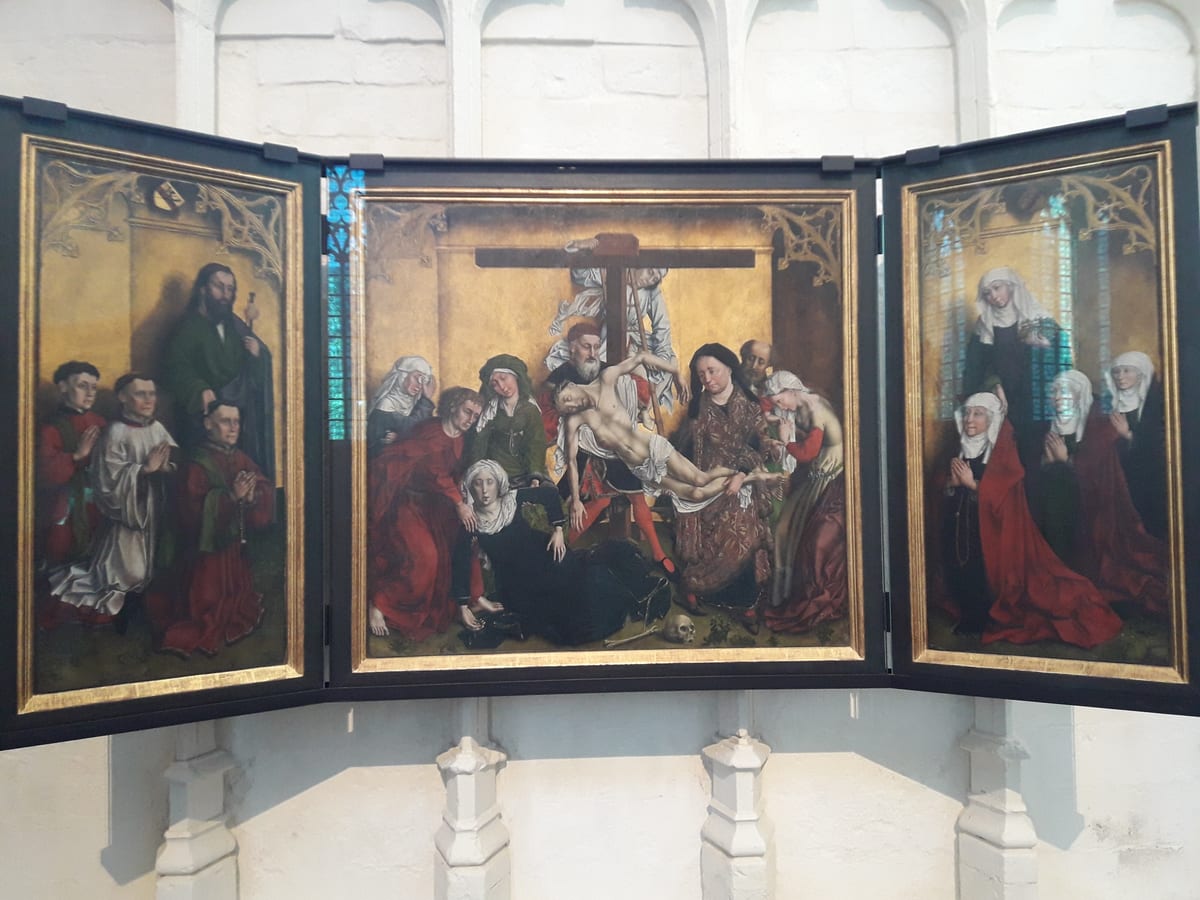
Edelheere Triptych (Descent from the Cross), right wing: Aleydis Cappuyns and her daughters Aleydis and Catharina presented by Saint Aleydis — photographed in situ, Unknown Brabantine master, after Rogier van der Weyden (photograph by Pere López Brosa), 1443 AD (photograph June 28, 2022 AD) Unknown Brabantine master, after Rogier van der Weyden (photograph by Pere López Brosa), Sint-Pieterskerk, Leuven, Belgium; inventory S/85/V, M Leuven / Saint Peter's Church With the years St. Alice took the monastic habit and grew in the observance. She walked always with her head bowed, holding herself guilty before God. At work she was strong, brisk and never idle.
Her thirteenth-century biographer calls her the consoler of them all and the refreshment of each one. She bore the weaknesses of others patiently and did not repay injuries. Keeping a night vigil before an altar, she saw a golden cross let down to her on a cord.
-
1242 AD
Leprosy at twenty-two
The disease took her out of the community, and the first night alone broke her.
The Roman Martyrology records that leprosy struck St. Alice at twenty-two. Her thirteenth-century biographer wrote that it came not for the guilt of any crime, but by way of a visitation.
Because the disease was contagious, she was separated from the community. On the first night alone she gave way under the grief. Afterwards she said she would refuse her former health if the choice were hers.
-
c. 1246–1249 AD
The house built for her alone
A dwelling went up for her on the abbey grounds, and at the altar she was moved away from the chalice.
For nearly four years St. Alice lodged elsewhere while a house was built for her alone. On the day she entered it the Lord appeared, standing in the room with his arms spread wide. He promised to stay with her as long as she lived in the body.
At the altar she alone was moved away from the chalice, which lepers were forbidden to approach. She complained inconsolably of being deprived of so great a gift. A voice from heaven told her that whoever tastes his Body is refreshed by his Blood also.
-
1249–1250 AD
A year given, and both eyes
Anointed on St Barnabas' day, St. Alice was told she had a year, and she offered each eye for a king.
On June 11, 1249 AD St. Alice had herself anointed with holy oil. At midnight the Lord showed her that she would live one year more. He told her that year would bring heavier weakness than all her life before.
The disease took her right eye, which she offered for William of Holland, King of the Romans. In the week before Pentecost the left eye went, and she was wholly blind. That loss she assigned to the King of France, Saint Louis, then on crusade.
-
1250 AD
The road she would not walk again
A crippled foot ended her going out, and from March she was in torment three and four times a day.
On January 23, 1250 AD St. Alice stopped halfway home from the church. She foretold there that she would never walk back to the church alive. Within days an infirmity in her right foot ended her going out.
From March 13, 1250 AD she was in torment until the last days of her life. She told her sister Ida she bore it for the dead and for sinners. No limb was left sound but her tongue, with which she sang God's praises.
-
June 1250 AD
Dawn on St Barnabas' day
She was anointed a second time, named the hour, and died at sunrise a year to the day after the first anointing.
On the vigil of St Barnabas St. Alice had herself anointed a second time. She told the nun sitting with her that she would pass out of this world about dawn. After Compline she said farewell to her friends and commended her soul to God.
At sunrise on June 11, 1250 AD, before Prime, she gave up her spirit. A small girl asleep in a village nearby dreamed at that hour of her soul carried to heaven. The child's mother came to the monastery and found her already buried.
-
1698–1907 AD
Forgotten, then given a feast
Her own abbey had lost her memory when the Bollandists came; four years later the Church gave her back a feast.
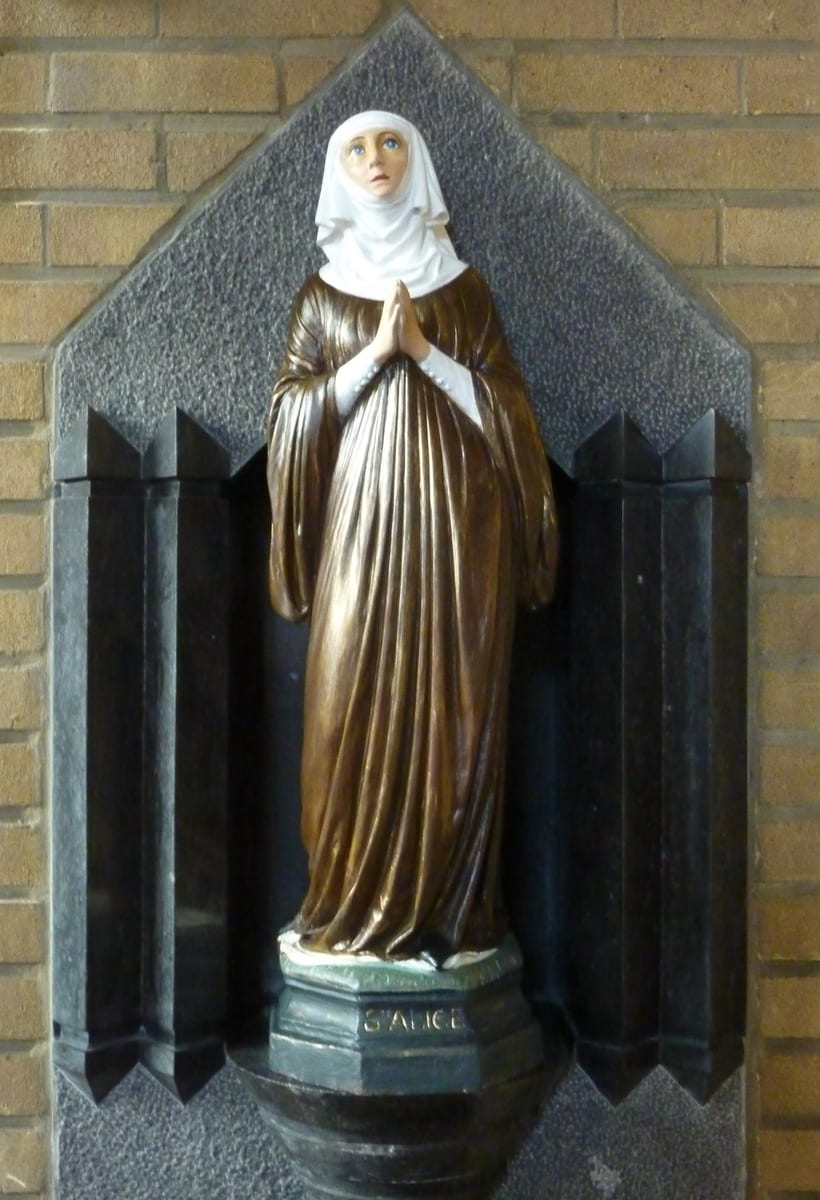
Église Sainte-Alice, Schaerbeek — the parish's image of St. Alice, Photograph by Lumixbx (Wikimedia Commons), January 23, 2012 AD Photograph by Lumixbx (Wikimedia Commons), Église Sainte-Alice / Sint-Aleydiskerk, avenue Dailly, Schaerbeek, Brussels-Capital Region, Belgium In 1698 AD Godfrey Henschen printed her thirteenth-century Life in the Acta Sanctorum. He found scarcely any memory of her surviving among the nuns of La Cambre. Henschen wished that her body might be brought to light and translated with due honour.
By decree of July 1, 1702 AD Pope Clement XI gave the Feuillant monks her feast. Pope Pius X authorised it for every diocese of Belgium in 1907 AD. The Cistercian Order and the diocese of Mechelen keep her feast on June 15.
“Alice died on St. Barnabus' Day, Saturday, 11 June, 1250. Cistercian monks did not hold a feast in her honor until 1702.”
the Kenyon College Margin project, reporting Fr Martinus Cawley OCSO, 1994 AD


Pray with the Church
The prayer of Saint Alice on the feast of the Eleven Thousand Virgins
St. Alice's own prayer at the threshold of her house, preserved in the thirteenth-century Life and printed by the Bollandists in the Acta Sanctorum under June 11.
Rogo te, Pater sancte, licet modo, prout desidero, cum ceteris Virgines sanctas laudare nequeo;& pro speciali dono, quo me ditasti, ad præsens Conventui mihi non liceat conjungi;propter magnam tuam clementiam, post hujus vitæ miseriam, ab earum saltem societate non patiaris me separari.
All 2 reports on Saint Alice of Schaerbeek

About this picture
AI-generated image, in the manner of a fifteenth-century Netherlandish oil on oak panel, from the paper's reference portrait based on Edelheere Triptych (Descent from the Cross), right wing: Aleydis Cappuyns and her daughters Aleydis and Catharina presented by Saint Aleydis (Unknown Brabantine master, after Rogier van der Weyden, 1443 AD, Sint-Pieterskerk, Leuven, Belgium) View source artwork.
Leprosy keeps St. Alice from the chalice; a voice from heaven answers

About this picture
AI-generated image, in the manner of a fifteenth-century Netherlandish oil on oak panel, from the paper's reference portrait based on Edelheere Triptych (Descent from the Cross), right wing: Aleydis Cappuyns and her daughters Aleydis and Catharina presented by Saint Aleydis (Unknown Brabantine master, after Rogier van der Weyden, 1443 AD, Sint-Pieterskerk, Leuven, Belgium) View source artwork.